Monday, December 01, 2014

Guest Post by Anjo Bordell

Anjo Bordell has lived in Shanghai, China since 2007. He completed his debut novel Default in the summer of 2014, and describes it as “half expat novel, half great American adventure.” It is available here on Amazon.

Please sign up for his newsletter, a hilarious and informative monthly dispatch from Shanghai with photos and short podcasts.

This lengthy guest post is also available as a (very entertaining) podcast. Click here for the audio download or here for the player. Pro tip: Listen to the podcast while reading along and clicking the links! Click here for the Kindle version of Writing an Expat Novel.

Visit: anjobordell.com Contact: anjobordell@gmail.com

WRITING AN EXPAT NOVEL

“If you could fight any celebrity, who would you fight?”

“Hemingway,” says Tyler Durden.

Good answer. I’d roundhouse that geezer until he was on life support. After his crimes of shooting unarmed POWs in the face and having written The Sun Also Rises, he’s left me no choice. “Blimey, old chap! Another apéritif?” Screw you, old timer. “Café crème?” Smack! And then he had the audacity to Cobain himself on the same day Céline died. Who made the front page? The genius? No, the murderer, the so-called expat novelist.

Maybe the escapades of “lost” interwar boozers yapping about irrelevant nonsense made for great expat writing in the 1920s, but these days, churning out something so inexcusably mundane should earn you an immediate ticket to permanent obscurity.

Brass Tacks, Not Bullshit

Say what you want about Shanghai, this magnificent city of the future where much of my novel Default is set, but it is anything but mundane. Indeed, China (and most of Asia) offers an endless supply of situations, settings, and characters so bizarre and morbidly fascinating that the writer who finds himself here will soon realize he has enough material to write a new book every week. And this is the perspective from which this broadside has been written—an American white boy novelizing from the teeming depths of Shanghai. Not in Shanghai? Lucky you. Just apply what I’m saying to the context of stories from anywhere. And regardless of where you’re writing from or about, always remember that modern readers don’t want a contemporary rehash of The Sun Also Rises. I don’t, anyway. The original was bad enough.

With so much compelling madness going on around him, the crafty expat novelist knows better than to defile his book with talk of Starbucks and iCrap, and the boring banter of bourgeois baloney. Shanghai is chock-full of that, by the way. Fiction fans are seeking escape, and the tedium of stateside suburbia already offers a generous bounty of these post-millennial plagues. People want “foreign” and “exotic,” not KFC and Facebook. They want dark alleys and intrigue, not bonbons and Louis Vuitton. Uncertainty and suspense, not silly, superficial romances.

Speaking of which, I could be terribly mistaken about all of this, as evidenced by the massive success of a book like Eat, Pray, Love, which tells of the pseudo-spiritual pseudo-awakening of a globe-trotting narcissist searching for pseudo-happiness. Yes, it’s a memoir, but you get the idea. I say we’ve endured enough of this inconsequential claptrap, the middle class musings of an ungrateful bore. What the world needs is straight talk, unencumbered by the poisons of political correctness. Boots on the ground, both barrels. Brass tacks, not bullshit.

You see a lot of both when living abroad, and much of the BS that’s been festering in your head will get rewired into something approaching truth. Or at least a new angle, a different lens through which many assumptions are corrected, refocused, and understood anew.

Travel is fatal to prejudice, bigotry, and narrow-mindedness, and many of our people need it sorely on these accounts. Broad, wholesome, charitable views of men and things cannot be acquired by vegetating in one little corner of the earth all one's lifetime.

So says Mark Twain. I understand the sentiment, but it’s only partly true. Yes, Americans in particular would do well to broaden their horizons, and that’s exactly what happens when you move overseas. But see what a stint in a country like China does for your “wholesome, charitable views.” Prejudice and bigotry? Don’t get me started. Sometimes we’re enlightened to the point that it’s worse than the BS we’ve been fed all our lives.

These charitable views apply not only to your host country, but even more so to the country you’ve bailed. You might think “bailed” is an exaggeration, but as your passport fills with stamps and stickers in languages other than your own, you come to realize that is exactly what you’ve done. And for good reason.

Many of us had the feeling we’d been living ringside in some kind of neo-Weimar freak show long before we “bailed.” But now, the view from outside the fence is so much more objective and sharp, like an unstable image on an old TV made clear with a good slap. This is the true value of witnessing the world with long-term immersion in a parallel universe, an alternate reality from which our notions and judgments of our personal history, opinions, culture, and general way of thinking get a tune-up, a recalibration that can neither be avoided nor reversed.

Ringside: the perfect way to describe the foreigner’s life in Shanghai. But it’s a different kind of circus, one we learn to tolerate as simple annoyance or entertainment. Trivial shenanigans compared to what we’ve escaped, which, as we confide among ourselves, can only be described as daily indications of the imminent downfall of the West.

From my novel Default:

We were well past the days when, if asked to describe the future, one would conjure up images of bright blue skies with cotton clouds and smiling Norwegians flying around in puttering air cars. But we hadn’t yet descended to the point we’ve reached today when, if asked the same question, one either comes up blank or flat-out refuses to answer, cursing you for ruining the entire day by having to think of such terrible things.

Pending apocalypse or not, the need for a respite can get the best of even the most hardened expat in the form of a round-trip ticket to the West. Not everyone is immediately appalled at what they see during the rare vacation back home, and I will admit to the usual symptoms of staring open-mouthed at blue skies or at the stars at night. Proper climate control and big fat steaks. Unfettered, blazing internet, blue eyes, and boobs. But the high quickly fades, and the creeps begin. Old hang-ups and phobias, even revulsion and fear—reminders that we’ve become outsiders in our own countries, and that even short, infrequent visits are more than enough. Further reminiscing grows futile as we realize the cursory perks of home aren’t really the nostalgia we’d thought we were looking forward to, but rather confirmation, closure of everything we’ve left behind.

Temperaments vary, of course, and not all expats have such a negative reaction to a first-world vacation. Some of my friends reached their limits long ago, bought one-way tickets west, and bailed China for good, vowing never to return. But we have all suffered similar misconceptions born from our diverse starting points, and by assuming some risk and seeking a little adventure, we have gained invaluable insight that will serve us well no matter where we end up, especially those of us who fancy ourselves writers.

Characters and Foreign Environments

Jaded businessmen, stoned engineers, ultra-capitalists. Losers, drunks, deadbeats, and the occasional drifter turned novelist. An all-star cast of post-imperialists, unrepentant and unapologetic. Nothing two-dimensional here, no boring dialogue or lack of at least mild intrigue. Just pay attention and your novel writes itself. Up against the wall of an unpredictable alien environment, these characters, these self-imposed exiles—

Oh, what’s this? A knock at the door. My friend from down the hall, the Spanish architect. I don’t like the haggard look on his face. Puts me off my writing game. “Everything alright?” I say. Urgent news. Big changes coming soon. He’s just learned that all the foreigners in the building have to scram. “Who told you that goddam lie?” He says he heard it from the maintenance man. “Seems a little far-fetched, since I just spoke with him about the pipes and he didn’t say a word about this!” He asks me if I’ve all of a sudden learned Chinese. I tell him that’s preposterous. He gives me a look that says, “I’ll let you figure that one out for yourself.”

The Texan next door sticks out his head. A rare scene—he and the Spaniard going at it in rapid-fire Chinese. I hold up my hands and point to my face. They get the idea and switch to English.

“The landlord told me it was because of renovations. I figured it’s because I’m black.”

“Renovations?” says the Spaniard. “Remember those soldiers we saw snooping around last week? Apparently, the People’s Liberation Army just liberated this building. So guess who they don’t want around anymore?”

“Blacks?”

“Any of us,” I say. “How much time do we have?”

“Nobody knows,” says the Spaniard.

Tex has heard enough. He slams his door. The Spaniard and I listen for a few seconds at the cursing and crashing inside the Texan’s apartment.

I wouldn’t mind having a go myself about now. My face is straight, but I’m seething inside. For weeks I’ve been anticipating diving into my second novel in my little concrete cave. So much has been written here already. History, greatness! Oh, but my passport says otherwise. Even though I’ve faithfully paid a fistful of redbacks every month for four years (without complaint!), this dirty foreigner’s money is no longer good.

What a shame to have to leave. And for the most laughable of reasons. A hate crime, where I’m from. Shanghai—city of the future, my ass! It might make sense if they’d simply said they didn’t like the looks of me, or had tracked me down after the release of Default. “We no like how you portray our city like circus!” Truth be told, I tried to be as fair and balanced as reasonably possible. But in Book Two, the gloves come off.

Things could be worse, I suppose. I could have been deported—again. Back in 2008, they were taking their Olympic debutante ball very seriously. Thousands of us were caught in a dragnet of nationalistic paranoia, and promptly returned to sender. Lesson learned? Of course not. Most of us came back as soon as we could. Gluttons for nonsense. Hedonists, lechers, powerless against our impulses and the allure of the Orient. The perfect destination for a writer. China—a never ending source of material so ridiculous that most of it is unusable because no one would believe it.

Kicked out by these miserable racists! Must try to stay positive. A lot of good that’s ever done. I’ve even tried to maintain a semblance of integrity. And it’s been years since I’ve had to explain to some very unfriendly cops exactly from where and whom my sketchy work visas had been issued. No more. The straight and narrow! Playing by the rules, and then this happens. Indeed, the thanks I get for putting myself in the poor house writing my novel. Reaping the many rewards.

The Spaniard interrupts my mumbling rant. He says something about our deposits. I give him a look. He takes a step back. I tell him the landlord and the maintenance man are having a laugh in the KTV downstairs, blowing our deposits on ketamine and hookers.

“Ketamine?” he says. “From carrots?”

“Hmm . . .”

I’m thinking about the move. Guess I’ll start looking for a place as soon as I knock out this post. Maybe somewhere near work. Commuting is no way to live. But oh, the dread of moving to Zhabei. Sure, the rent is cheap, but for good goddam reason. Mile after mile of tenement blight, smog, and phlegm. But I’ll save some cash. A couple more years and I’ll be able to bail China for good, vowing never to return.

See what I’m saying? Life is loose. Disaster can strike at any minute. Periodic crackdowns on this or that. Bus fires, building fires, train wrecks, war. Immigration snafus! Graft, theft, greed, general incompetence that can blow a good plan to smithereens. Thugs and cops could burst into your brothel suite right at the moment of truth. Poison milk and gutter oil. SARS, bird flu, swine flu, and this most recent affliction: not being Chinese.

Bright side, Bordell! A minor issue in the grand scheme. At least it got me writing again. I was hopelessly stuck, but now I can show you exactly what I’m talking about. Foreign environments can explode in your face without notice, leaving the intrepid novelist, once he’s calmed down, with a whole new chapter.

Where was I . . . Ah, I was about to tell you more about all the lovely folks you come across in this haphazard habitat. And the locals—don’t get me started. All smiles and emphatic bows until the president makes some offhand remark about the supposed sovereignty of Taiwan. Bite your tongue, sir, for it is the lowly expat who pays the price of your geopolitical indiscretions! Today, just eviction. But tomorrow, who knows? The gulag? We won’t stand for it!

We came here for opportunity and adventure. And when the time is right, we’d like to leave with happy endings and fistfuls of green. No desire for a last-minute chopper escape from the roof of the Ritz. But can you imagine? This lot? Look at us, so varied, so colorful—characters with personas as unique and rare as our very DNA. The Turk, the Dane, the Mad Belgian. The Pope, the Queen, Sexy Barkeep. The Spaniard . . .

He snaps his fingers in my face. “You okay?”

“You’re from the Canary Islands, right?”

“Yes, why?” he says, before looking over my shoulder to my open laptop. “Please don’t put me in your stories, Anjo.”

“Stories?”

“You know what I’m talking about.”

“Don’t worry. No one reads my stuff.”

He’s shaking his head, about to say something else as I shut the door.

Equipment

Hardly anyone uses a typewriter anymore, that time-honored battle ax on which countless of our favorite books were written. But the essence and vigor within that industrial clamor can still be summoned by typing on my weapon of choice: the mechanical keyboard. Invest in eternity—big and clunky, blue switches if possible. Anything worth doing!

I doubt much of any significance has ever been written on cheap, effeminate tap pads. Most garbage they sell these days are so metrosexual, so anemic, so . . . bloodless. Mac? Degenerate nonsense! Manicured, silent little widgets, so dainty and pale, engineered for maximum emasculation. Candy-coated impotence, unfit for writing even the most trivial of emails.

But clackety-clack! You know what that is? The sound of your roommates kicking you to the curb, your wife rescinding her vows. Progress, productivity—the sound of your novel being written. Noise, glorious noise! Like the jackhammers outside my window. And you, your words, your scathing indictments—take another swig of Chivas as you write your stories in maddening, explosive keystrokes, subversive prose roaring across the page—evidence of your existence, proof of your creative power, your vitality, your final purpose.

The keyboard I use is 100% double-fisted badass, tough, reliable, and loud.

Much of my novel was first written with old fashioned pen and paper. I recommend finding a pen you like and buying five of them and fifteen refills.

About this pen and paper . . . As you cut the lights before bed, make absolutely sure that your writing tools are within easy reach. I have a notebook and pen assigned to this post, never to leave my bedside except when transcribing the pages on my computer with my noisy keyboard. (A separate notebook and pen(s) are in my bag at all times.)

Very important: As we shut our eyes, we must be ready for those beautiful checkmates and ingenious plot twists to fall from the heavens into our pre-sleep subconscious. These are lucky breaks, offerings bestowed upon us from the cosmos of creation that’s always swirling around us. We must treat these gifts accordingly. Their value is immense and the price is merely switching the light back on and putting pen to paper.

We’ve all told ourselves at some point that “this is such an obviously grand maneuver that only an idiot would forget it by morning.” Then back to sleep, smiling to ourselves at how incredible our ideas are and how swimmingly our book is coming along. And then halfway through the next day we’re vaguely aware that there was something important we should have remembered. I can’t speak for everyone, but I never remember. Once I realized how indispensable were these bedtime brainstorms, I never chose sleep over inspiration again. And had I allowed laziness to prevail, my book would have been far inferior to what it has become, or would never have even been completed.

Routine

Everyone does his own thing. But my life is so impossibly fascinating that I’m sure you’re just dying to know about my personal writing routine.

China is loud, even louder than my keyboard, especially ground zero in a mess like Shanghai, and even more especially with the busy intersection below my window. I’m used to it by now, with two notable exceptions: the curse of the hammer drill, and the old man outside, street level across the way, who plays the instrumental theme to Titanic on infinite loop on his little radio made for old deaf people. Even with all the traffic, bus horns, shouting, sirens, and street cleaners, I can hear that old man’s radio as clearly as if it were sitting on my desk. And that song is really, really annoying. But God bless him. Haven’t seen him in a while. Hope he’s okay.

I can write during the day, but it’s not optimal. I’m most productive in the hours before the sun shows up for its usual morning struggle against Shanghai’s atmospheric filth. If I get to bed on time, around 9pm, I’ll be up at four. I’ll drink half a liter of warm water with the juice of two lemons. (No Chinese hocus pocus here. I’m worried about kidney stones. Once was enough.) Then a steaming mug of Bulletproof coffee and half a pack of Reds. Coffee is one thing. Bulletproof is another. It should be the standard breakfast of writing champions everywhere.

Civilization is quiet, and only those of us who have been deprived of the relative noiselessness to which we are accustomed can fully appreciate it. An early start with a clear head ensures the best conditions from which imagination can burst like a supernova through the splendor of silence. I can write full tilt until the bar girls come home at 5:30, tramping up the steps and chatting down the hall, finally returning my solitude with the slamming of their apartment doors. The sky brightens, a thousand buildings come into view, traffic increases, and I’m done by 6:30, maybe 8:00 on weekends.

A few hours of daily stress cripples my creativity, so afternoons are less productive. Sometimes I’ll spend three hours on one lousy paragraph, cursing out loud my hermitic calling, disgusted with the entire situation, and wondering if fifteen stories is high enough for an effective cure.

I’ve tried writing in coffee shops. Of the 100k-plus in this city, I’ve found a couple of decent spots, with soft music and comfortable chairs. But like a lot of places in Shanghai, they vanished without notice, were gutted, and a week later rechristened as real estate offices or banks. I’ve tried a few others, but even when empty, the Whitney Houston and Kenny effin’ G. blasting through the speakers got old in under a minute. I don't bother anymore, resigning myself to writing at home in my dilapidated dugout. You should see these digs. Most people would be appalled if they saw the conditions in which I live and write. They'd buy my book out of head-shaking pity. I can't even bring local guests here. I've learned my lesson with that. And now that I’m getting the boot, things are about to get a lot worse.

But anyway, I like a view. Not that the view I have now is so great, but it’s something. Distance in front of me, an expanse to absorb my stares. And there’s a certain third-world urban loathing in my surroundings that keeps me in check. I fear being mesmerized by a better environment. A more picturesque setting, like a misty Irish coastline or a panorama of Rockies, could sap my ability to write with such caustic mockery. My conscience might not allow it. The devious creativity on which I depend might turn soft and sentimental, and this is not a risk I am prepared to take. Like it matters. Barely a buck to my name. So, for now at least, Shanghai it is.

Distractions

I don’t mind the odd, unplanned distraction, as long as it’s entertaining. Like the occasional fist fight in the street below, or fireworks going off in my face, provided it isn’t during Chinese New Year, when the novelty of fireworks wears off after the first of many 24-hour periods of uninterrupted incoming. And even that is preferable to the hammer drill and the old man’s radio.

The internet isn't too much of a distraction for me, especially in China, where the blood-boiling ritual of connecting to the outside world is far more distracting than the would-be content. But mobile messaging apps will kill your productivity. I've had to quit chat groups altogether because I couldn’t get anything done. It isn’t so much the time that’s stolen, but your attention span, which will eventually be reduced to a generous five seconds. And it's not enough to merely put down the phone, because you’ll still have that constant urge to check what new hilarious and very important messages have been posted, and how you can contribute to such earth-shattering discussions. Cold turkey, friends. On par with quitting smoking. And be ready for withdrawals—the shakes, depression, and loneliness. But come deathbed regret day, I doubt you’ll be wanting to trade all the books you’ve written for another animated meatspin. This is just my experience, of course. If you can write your novel in five-second increments, then by all means.

And TV is a bottomless black hole of time, soul, and productivity. Nothing new here. They make excellent targets at the range.

Prestige

Steve Albini, sound engineer extraordinaire and peerless champion of the analog medium, has said that if he were to cease presenting bands with reels of magnetic tape documenting their grinding toil in the studio, and instead were to simply hand over a digital file, then he would “feel like a fraud.”

Indeed. And while “ebooks are forever,” as Lord Konrath says, they’re about as prestigious as MP3s. On the fringe of physics, they barely exist. The fruits of our struggle, years of drudgery, reduced to faceless data. I hate telling people, after they learn of my novel, that it's only available as a crappy digital file. Do I “feel like a fraud?” Not exactly, but there is a certain dismissive sentiment, on both sides, that the author and his work have been confined to amateur hour.

After all, any jackass can upload his miserable tripe to the internet. Just like indie bands. But musicians showcase their true worth by performing live, which is much more effective for gaining fans and income than a lousy author’s website and feeble pleas to “buy now” and prayers that unsuspecting readers will invest hours of their precious time reading your book, actually liking it, and then telling ten thousand friends.

But yes, I have effectively bypassed the Manhattan puppet masters and have therefore avoided years of low-crawling through broken glass. And the money is already rolling in. All twelve dollars of it.

I gripe about our measly digital files masquerading as “books,” but I concede that Amazon has done a remarkable job with its development of the Kindle. I was a diehard, and they had skeptics like me in mind when engineering this little device that may prove to be more profound and game-changing than the so-called smartphone. I still revere the superiority of paper books, but the Kindle is a worthy second.

What about CreateSpace? My apologies, but if I were ever to see my book in bound paper, I would never settle for less than a proper offset printing. I’m very particular about presentation and quality, and with paper books, only industry standard can satisfy my demands. Anything less would be like watching a brilliantly shot movie on dusty old VHS. In mono. It’s hard for me to enjoy the content when I’m being distracted by the inferior format. And I would find it difficult to live with myself if I were to subject my readers to standards beneath my own.

It’s not just me. Everyone knows there’s more status in having a traditionally published book. But I suspect, as we all do, that this lamenting of self-publishing’s lack of prestige will diminish in the coming years as young readers, brought up with various devices in their faces at all times, are less instilled with the pleasure of paper books, and will have little nostalgia for these relics from prior generations.

But until this becomes “normal,” self-published Kindle authors will be fighting an uphill battle of preconceived notions of illegitimacy. This makes it all the more important that we are fanatics in our pursuit of excellence, and that we refuse to settle for anything less. This is our responsibility to ourselves and the poor reading public, whether you’re writing an expat novel, a self-help book, or a dystopian epic about nuclear zombie . . . lesbians.

Simple Things To Avoid

I’ve never been much of a team player, but some of the rules of our trade have been established for reasons that are incontestable.

“Ah, thank you, Bordell! How many books have you written? One?”

Yes. But even so, I am well aware of certain foibles to avoid, glaring weaknesses I sometimes see in the writing of even “properly” published authors. I’m no expert. But the internet is. Just do a search for the overuse of dialogue tags and LY-adverbs. How these infirmities have yet to be eradicated is beyond me, but your writing will click up a notch by simply reducing them to an acceptable level.

Flat characters and boring dialogue are common complaints of dissatisfied reviewers. Remember this, and write accordingly. With an international cast ranging from charismatic to shady to outright full of shit, there is no excuse for flat, uninspiring discourse in an expat novel. Make your dialogue realistic and interesting whether or not it’s actually “moving the story forward.” Extra points if the reader laughs out loud.

Keep in mind that your book needs to pass the expat smell-test. Make sure you know, or at least appear to know, what you’re talking about. And readers back home might not notice the hackneyed accounts of over-tread foreign subject matter, but people with experiences similar to your own might cringe. Some things are inevitable, such as confusion resulting from the culture and language barrier. But use your judgment and try to avoid the more wince-inducing clichés of the country in which your novel is set.

Watch the overuse of foreign words. My first draft had too many Chinese terms, phrases, and street names scattered about. Then I realized they added nothing to the story and were like unnecessary narrative speed bumps. All but a very few got the ax. Of those remaining, if the meaning isn’t immediately obvious, then it’s explained later, but not necessarily defined. This is an important distinction, akin to “show don’t tell.” Explain the meaning in the context of the story, or otherwise cleverly insert it into the following dialogue.

I touched on this earlier—my disdain for the use of pop culture terms and brand names, especially when related to our ubiquitous connectivity. iPhones, Facebook, Twitter, selfies, YOLO, etc. Don’t talk about this crap. In the interest of making your novel as timeless as possible and not so immediately dated, be very careful with the use of these timestamps of fleeting relevance. Mentioning Facebook is one thing. But imagine having written your novel a few years earlier and your hero was using MySpace. Or dialing up to CompuServe on his 486 to do a Lycos search for PB Max on the World Wide Web.

Everything today is so transitory and cheap. Make your work the exception. Ebooks are forever, yes? Then we must write like we believe it. After all, I’m talking about writing a novel here, not a blog post. The ebook format is flighty enough. There is no need to make it even more throwaway. We should treat our work with a sense of permanence, and avoid the mistake of choosing the low road of our temporary culture, awash in gizmos, gadgets, and gimmicks. Because in the space of one year, an otherwise timeless novel could become as irrelevant as The Sun Also Rises.

Shortcuts and skimping will sabotage your efforts regardless of what you’re trying to accomplish. Anything worth doing, remember? So don’t skimp on your artwork! I went with awesomebookcovers.com and I think the results are fantastic. Note to Amazon: if our book covers are so important, then why has your pathetic resizing algorithm destroyed my colors, eh? I’ll tell you what—sign up for the newsletter on my website and I’ll send you a link for a downloadable poster. Print it out four feet across. It looks amazing.

And if you're not going to hire an editor to wade through your sloppy mess and turn it into something worthy of your good name, then you are wasting your time as well as everyone else's. I didn’t skimp on Default, and I didn’t rest until I got the results I wanted. And while readers might disagree on how many stars it should receive for story and style, I am absolutely certain that no one will lump my novel in with that contemporary scourge of ebook self-publishing: the “tsunami of crap.”

Closing Argument

Expat or homebody, novelist or pamphleteer, we are all witnesses to global changes of historic proportion. Whether it’s confrontation between restive empires or the proliferation of this little device called the Kindle, the Order is in transition, and these shifts in power are nothing short of momentous.

Regardless of what the future holds for the victims of international upheaval, I agree with Lord Konrath when he says there has never been a better time to be a writer. And if you combine this with the intoxication of an increasingly unstable yet readily travelable world, I’d say it’s even more true for the expat novelist.

But there’s no Parris Island for this, no drill instructors kicking our butts and violently molding us into professionals. It’s up to us to lay on the hate, putting our miserable selves through this awful, desolate gauntlet of writing, editing, publishing, and promotion.

Everyone has a “voice” now, for better or worse. Don’t waste yours. We must do our part in breathing life back into a culture that has become so childish, superficial, and complacent. Make your life count, make your writing count. Write every day like it’s your last. Write every book like it’s your last. Carpe diem, carpe librum.

Become a fanatic. Aspire to greatness.

Monday, November 24, 2014

A Novel Approach To Box Sets

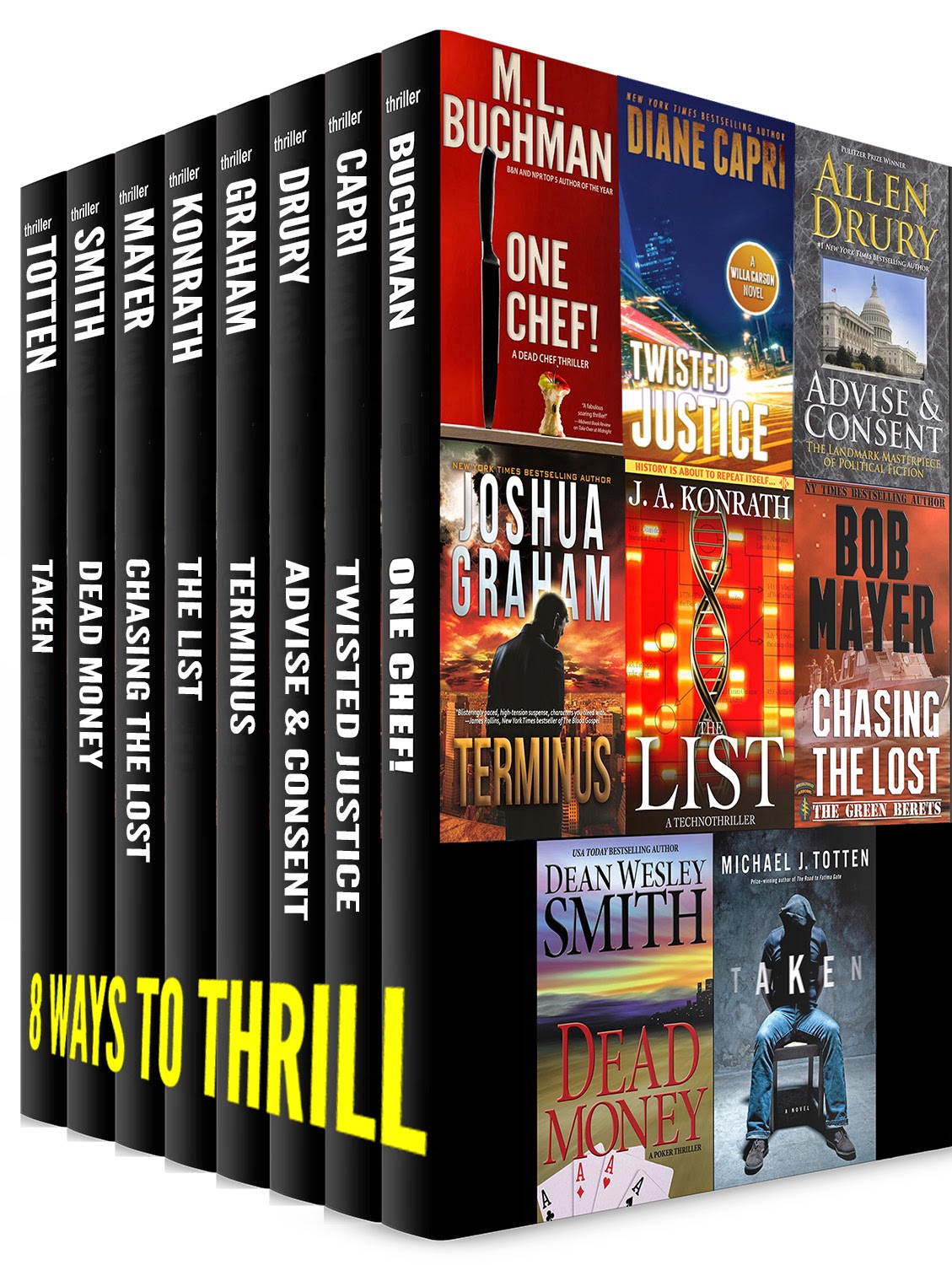
8 Ways to Thrill - Unique Ebook Bundle Available Through 11/27/2014

Available at http://storybundle.com/thriller

My thriller The List is available in a discount eight novel thriller bundle until Thanksgiving.

Box sets are one of the hottest promotional tools going right now, so I interviewed the bundle’s curator M.L. “Matt” Buchman.

Joe: What's the main idea behind this unique bundle, and how did you come up with it?

Matt: I’ve worked with StoryBundle.com a couple of times and I like their structure. The reader sets the price. For $3 they get half the titles, for $12 they get all eight. For more than $12, they also get the author’s undying gratitude! I like the friendliness of that structure.

For this bundle I wanted to put together a kick-ass group of thrillers. So I set myself two missions: 1) Gather a group of thriller authors who I myself am just dying to read/read more of, 2) Try to offer as much variety as possible.

The first part came together with surprising ease, everyone that I approached jumped right in (thanks folks). So I got my first-tier choices all across the board. The second part also came together, somewhat to my surprise. Thrillers have a wide variety of subgenres and this one bundle actually covers most of them: Legal, Military, Political (both governmental and terrorist), Supernatural, Techno… On top of that, we also cover the range from gritty and hard-hitting up to the lighter ones like my foodie thriller and Smith’s poker thriller.

This works as a great collection, and also as a great “taster’s choice.” On the one hand, it welcomes new readers to the genre. On the other, experienced thriller readers will get some of the best writers working in the genre today.

That takes a firm vision by the curator of the bundle and is awesome when it works this well.

Joe: How does something like this get promoted?

Matt: The premise of bundling, and why it works so well, is cross-promotion. Mayer’s military thriller audience may not know about your techno. My fans following me from my military romantic suspense series (The Night Stalkers and Firehawks), may well be new to all thrillers. It is through the individual authors promoting out through their websites, feeds, street teams, etc. that makes these types of efforts really work. That is a key failure/success criteria: are ALL of the authors in a bundle willing to promote it and do they each have disparate platforms from which to do that?

Joe: Explain how sales work.

Matt: Storybundle.com is a unique system that I haven’t seen elsewhere. It is a limited-time bundle offering a “buyer sets the price” structure. It even allows the purchaser to allocate a percentage of their purchase to literacy charities.

These bundles are not available through Amazon, B&N, etc. It is only available on their website. In turn, Storybundle handles mobi and epub delivery, servicing clients with problems, even long after the bundle is over.

They also handle the back end accounting which can be a definite challenge.

Joe: Do you consider this a success so far?

Matt: Whether I get my title into the hands of 50 new readers or 5,000, I consider the method a success. A friend of mine, Scott William Carter, coined the phrase WIBBOW (Would I Be Better Off Writing). The question is would I be better served spending my time writing than curating and promoting a Storybundle bundle. Every bundle I have done with them has more than paid back my time in direct monetary means, despite the deep discounting. After that, new readers and “halo effects” as they discover the other books in my Dead Chef series, or even expanding out into my military romantic suspense and other series, will continue to pay me long after this bundle goes away on 11/27.

Joe: Would you do this again? What changes would you make/chances would you take?

Matt: Absolutely! The bundling concept is now fairly common, both within an individual author’s series as well as a group of authors. The challenge is now: How to stand out? How to catch the reader’s attention? That is by taking chances. Storybundle had never had a thriller bundle before, but was willing to take a chance on me as I’ve curated other bundles for them. It was by both myself and StoryBundle taking that risk that made this bundle happen at all, never mind it also being a success. Upcoming from me the curator? I’m deep in developing a foodie mystery/thriller package and one of Seattle/Pacific Northwest contemporary romances. Military romantic suspense is definitely on its way as well.


Go there now!

Joe sez: I found this experience interesting for several reasons. First, because Matt did all the heavy lifting, and my workload was reduced to replying to a few emails, the usual Twitter and Facebook posts, and this blog.

Second, because this is truly a new ebook venue. I've found that discoverablility is often limited by the search-worthiness of the platform. Amazon has the best online store, best ebook shopping experience, and it sells a lot of ebooks as a result. But here is an entirely new platform, relatively unknown, using a unique way to pay and depending on the visibility of its authors. I'll be curious to see how much it earns each author, and will report back in the comments when I know.

The StoryBundle website is slick, easy to navigate, intuitive, and makes it simple to pay. I'd like to see an online forum, to help make the site become a regular hub for readers. Browsers then to return when they can leave comments and interact with each other. As it stands now, StoryBundle is a means to an end (authors promote bundles, readers click on in). Amazon has that, but people also come to Amazon to surf, browse, leave reviews, make comments, etc. The stickier StoryBundle becomes, the better it will do.

Taking chances, trying new things, being experimental, is how the Next Big Thing gets discovered.

So I encourage all of my readers to plunk down a few bucks and check this out, and let me know in the comments what your impressions are.

ABOUT M.L. BUCHMAN
M. L. Buchman has over 30 novels in print. His military romantic suspense books have been named Barnes & Noble and NPR “Top 5 of the year” and Booklist “Top 10 of the Year.” He has been nominated for the Reviewer’s Choice Award for “Top 10 Romantic Suspense of 2014” by RT Book Reviews. In addition to thrillers, he also writes romance, fantasy, and science fiction.

In among his career as a corporate project manager he has: rebuilt and single-handed a fifty-foot sailboat, both flown and jumped out of airplanes, designed and built two houses, and bicycled solo around the world. He is now making his living as a full-time writer on the Oregon Coast with his beloved wife. He is constantly amazed at what you can do with a degree in Geophysics. You may keep up with his writing by subscribing to his newsletter at www.mlbuchman.com.

Sunday, November 23, 2014

Don't Pay to Self-Publish

My name is Joe Konrath, and I write fiction.

I've sold over a million books by self-publishing.

You probably were searching for "how to self-publish" or something similar and my blog came up.

This post for all newbie writers considering self-publishing. While it would be extremely helpful to you to take a week and read my entire blog to get a full understanding of how the publishing industry works, here's the most important thing you need to know:

DON'T PAY ANYONE TO PUBLISH YOU.

Now you can certainly pay people to help you publish. Freelancers such as editors, cover artists, book formatters, proofreaders, and so on.

But when you hire a freelancer to assist you, you keep your rights.

That's very important.

When you write something, you own the copyright. That's automatic, even if you don't register with the copyright office.

Copyright means exactly that; you have the right to copy it, to distribute it, to give it away, to sell it. You own those rights.

But if you pay someone to publish you, you GIVE THEM YOUR RIGHTS.

NEVER GIVE ANYONE YOUR RIGHTS.

There are many publishers, called vanity presses, that exist to prey on writers who don't know any better. These presses are sometimes part of big, recognizable publishers, and it's easy to be tricked into thinking that if you pay hundreds, or thousands, of dollars, you'll be published by a major press.

The truth is, major presses PAY THE AUTHOR, not the other way around.

I have sold books to major publishers, and was paid hundreds of thousands of dollars, and then I had to hire lawyers to get those books back so I could self-publish them. Because I make 10x as much money self-publishing as I did by selling my rights to publishers.

If you are looking to get a publisher, do your research.

Check out David Gaughran, Writer Beware, and Preditors & Editors. They have a lot of information about publishers you should avoid.

Learn all you can about vanity presses. Don't get suckered in.

Ask questions. Seek answers. And DON'T PAY ANYONE TO PUBLISH YOU.

Now some Q&A.

Q: I saw an ad for a publisher. Are they legit?

A: Real publishers NEVER advertise. Anywhere. Ever. Not in magazines, or on Facebook, or in Google Ads. NEVER. If they advertise, avoid them.

Q: I saw a publisher at a writing conference and they have publishing packages that they sell.

A: Run away from them. Quickly.

Q: But they told me that self-publishing is hard and they'll do all the work.

A: And they will also KEEP YOUR RIGHTS. You can hire people to help you. Don't pay a publisher. Don't give your rights away.

Q: I have questions about a publisher.

A: Check out the three websites I listed above and search for that publisher.

Q: But if I pay this publisher, they promise to get me reviews and get my book into Ingram and...

A: DON'T PAY ANYONE TO PUBLISH YOU.

Q: Why not? What's the big deal?

A: First, they'll take your money. Probably hundreds, if not thousands, of dollars. Then they'll keep your rights, so if your book does become successful, they control it, probably forever.

I know a lot of rich self-pubbed authors. Not one of them paid to be published.

Q: But self-publishing seems so hard. There's so much to learn. I'd rather pay someone and be done with it.

A: Would you also say, "Investing seems so hard. There's so much to learn. I'd rather pay someone and be done with it."?

This is your money, your hard work, and probably also your dream and your passion. You owe it to yourself to do some work and learn the industry functions.

Q: I got this brochure in the mail...

A: Real publishers don't have brochures. They don't mail out anything to authors.

Q: I got this email...

A: Real publishers don't email authors.

Q: But they sent me a contract...

A: If you still aren't convinced that the contract is bad, have a lawyer look at it. One I highly recommend is David Vandagriff. If you're willing to pay money to a publisher, you should also be willing to have an attorney who knows publishing take a look at your contract. It will be the best money you ever spent, I promise.

Q: I'm confused. I have more questions.

A: Head on over to KBoards and introduce yourself. There are writers there who will help you.

Q: Why do you care?

A: You've probably heard that this is the best time in history to be a writer. That is correct. For the first time ever, it is possible to reach readers without having to go through gatekeepers such as agents and publishers.

But there is NEVER an easy path to success. If something sounds to good to be true, it is.

I began this blog in 2005 for newbie authors. It explains all about how publishing works. It's a public service I provide. If you're serious about publishing, take a few days and read through all of my entries. You'll get the equivalent of a Master's Degree in traditional publishing and self-publishing.

There have always been vanity presses, and unscrupulous predators who prey on eager, naive writers who have big dreams but no experience.

These companies will continue to exist only if writers remain uniformed about them.

Get informed. You owe it to yourself, your dreams, and your eventual writing career.

DON'T PAY ANYONE TO PUBLISH YOU.

Thursday, November 20, 2014

Preston Amok, The Bookseller Sucks, Antitrust Redux*

*To revel in the full majesty of this blog's title, please mispronounce redux as re-ducks.

Now go grab a pot of coffee and a bowl of popcorn. This is gonna be a long one.

Back in 1978, when I was but a wee lad of 8 (the smarter among you can probably guess my birth year if you're good at math) a book came out by a guy named George Fox. It was called Amok.

Even at that tender young age, I'd recently read Jaws (and you wonder why I'm a thriller writer?) and I picked up Amok at my local library in their paperback exchange rack. I selected it because of the cover; two muscular arms swinging a bloody sword, and the tagline: The blood-chilling bestseller more terrifying than JAWS.

I was reminded of that book while reading the latest Douglas Preston nonsense in The Bookseller this morning.

Speaking of non-sequitors, I recently came upon Paul Biba, an attorney and the former editor-in-chief of Teleread. Paul has an amazingly comprehensive Twitter feed. If you're at all interested in publishing, ebooks, and/or the laws that effect them, follow Paul. I asked Paul a few questions, which we'll get to in a moment.

This is coming off the heels of an exchange that several authors, myself included, had with Philip Jones of The Bookseller, where we tried in vain to get him to act like a journalist.

How does all of this tie together? Pretty well, actually. Let's start with The Bookseller "story" about Preston. Their unedited article in biased bold font, my replies in common-sense normal font.

Campaign group Authors United will continue its “efforts to persuade” the Antitrust Division of the Justice Department in the US to look into Amazon’s market practices, saying there are "still many open questions about Amazon's market power".

Joe sez: Amok was based on real-life events, about a Japanese soldier on a small island in the Philippines 30 years after WWII, who was never told the war ended. He's called Amok because he keeps running amok, killing people, even though the Axis had already lost the war.

You can see why I remembered this book while reading this article about Preston.

The group was set up by American author Douglas Preston during the dispute between Amazon and Hachette Book Group (HBG) in America over e-book terms, which was resolved last week.

Joe sez: Douglas Preston, who insisted he had never taken sides in the Hachette/Amazon dispute, and who doesn't seem to know that this dispute has been resolved, is still fighting the war in his head, and apparently trying to use Authors United as a bludgeon to get his way; namely, to get media attention to convince the DOJ to overlook 120 years of antitrust law and go after Amazon.

In a letter to the writers who signed petitions trying to persuade Amazon to agree terms with HBG - including names such as James Patterson, Stephen King, Tracy Chevalier, Sophie Hannah and Philip Pullman - Preston wrote that the deal between the two companies, which allows HBG to set consumer prices for its books, was “not unreasonable” as he understood it.

Joe sez: No deal is "unreasonable" if both parties willingly signed it. Besides, Hachette practically bragged about the deal.

“The new agreement will benefit Hachette authors for years to come,” said Hachette Book Group CEO Michael Pietsch, in a statement. “It gives Hachette enormous marketing capability with one of our most important bookselling partners.”

Preston, apparently licking his wounds and stuck in a confusion bubble because Authors United accomplished exactly zero, seems to still be trying to wrap his head around the fact that the war is over. Hachette got what it thinks it wants (the ability to price ebooks high), Amazon has financially incentivized Hachette to keep ebook prices lower, and the authors Preston was purporting to protect (remember them, Doug?) are now out of the line of fire and no doubt happy that their ebooks are once again discoverable on Amazon, albeit at a high price set by their publisher that most readers won't be willing to pay.

And Preston's comment? That the deal is "not unreasonable". Which is the most unreasonable thing he's said on this issue, and that's saying something.

“I want to thank all of you for your courage in facing down Amazon,” he continued. “Each one of you risked retaliation and potential damage to your career to sign our letters. As a Hachette author, I want especially to thank those many non-Hachette authors who had little to gain and a great deal to lose by taking a public stand.”

Joe sez: It was certainly brave of multi-millionaires like Preston, King, Patterson, and Child to speak out against Amazon, where they risked losing...

Um...

Uh...

What did they have to lose, exactly?

What did any of the AU signatories have to lose?

Did they fear the wrath of Amazon?

True, AU's incorrect stance was that Amazon had targeted authors. Maybe they actually thought, by speaking out against Amazon, they'd also become targets of that nefarious, illegal activity known in hushed circles as capitalism. Maybe Amazon, irritated by their bold actions, would do something reprehensible, like sell their books at their publishers' MRSP, instead of at a discount.

Or maybe Amazon would do nothing, because it doesn't target authors. Which is what happened; nothing. But medals all around anyway.

But Preston said the settlement did not change the problem that “one corporation now controls more than 50% of the book market in the United States -- a corporation, moreover, that in our view used its market dominance in an irresponsible and destructive way”.

Joe sez: So Preston, who insisted AU was there to protect authors, now wants AU to protect the industry from a corporation that sells more books than anyone else.

"They sell too many books! Make them stop!" says an author who makes his living selling books.

What does this lapse in logic remind me of? Oh yeah, my old post Presumed Inane, where former Authors Guild prez Scott Turow explained why we should fear Amazon.

The Big 6 were worried Amazon would no longer pay them $15 per ebook, so they forced Amazon to take a deal where Amazon only paid them $7 an ebook.

Bask in the logic of millionaire status-quo legacy authors.

He confirmed that Authors United would still be pursuing its aim, announced earlier this year, of asking the Justice Department to open an inquiry into Amazon.

Joe sez: Dear Doug Preston. I'd like you to sell my ebooks on your website, www.prestonchild.com. You'll sell them for $12.99 each, and you get to keep 30%. You'll do this because I said so. If you boycott or sanction the sale of my books on your site, or try in any way to make them hard for your readers to find, I'm telling the DOJ on you.

Preston said: “There are still many open questions about Amazon's market power. Those questions are best explored, not in an atmosphere of confrontation and high emotion, as we have just passed through, but in a reflective way that considers the long-term economic health of the book industry and the ability of authors to earn a living -- as well as the larger issues of freedom of speech, diversity and healthy competition in the marketplace.

Joe sez: "There are still many open questions about Authors United's actual intentions, since they've completely abandoned their original 'we take no sides we just care about authors' stance, and switched focus to what we knew all along: protecting their corporate masters' paper distribution oligopoly. Those questions are best explored by using the media, via parrotting lapdogs such as The Bookseller, who also have an anti-Amazon bias and will repeat whatever we tell them without any opposing views."

“For this reason, we believe it is vital to continue our effort to persuade the Antitrust Division of the Justice Department to look into Amazon's market practices. Our letter, and our behind-the-scenes work, is well in process and we feel it makes sense to see it through.”

Joe sez: Okay, I'm pretty sure Preston has no clue how antitrust law works, but we'll get to that in a moment.

First, I want to point out that the above text in bold is the entirety of The Bookseller piece.

Notice anything odd? I mean, beyond how silly it is.

How about the article's singular focus on reporting what Preston is doing, without even bothering to look at any other side of this situation?

Who could The Bookseller have talked with to round out this story? I can think of any number of authors who have publicly sided against Preston. Amazon might not comment, but at least The Bookseller could have said they tried to reach Amazon. How about asking Preston himself some tough questions, such as why he insisted he hasn't been taking sides and now obviously is? Or why he seems less than elated that the negotiations are over? Or if he thinks his silly organization made a difference?

How about asking a reader what they think? Or getting the opinion of a lawyer versed in antitrust law? Or asking anyone at all anything at all, to offer at least the semblance of an alternative opinion?

The Bookseller tends to do this a lot. So much so that on a previous piece, a few authors decided to point this very thing out in the comments.

The Bookseller's editorial editor, Philip Jones, replied to many of the comments. The piece can be summed up thusly:

Amazon Anonymous, a campaign group, doesn't want people to shop at Amazon because Amazon treats workers, society, and other businesses unfairly, and Amazon doesn't pay their fair share of taxes.

That's pretty much it. Go read it if you want to, but there isn't much more. Where it gets interesting is the comments.

Here is the whole amusing exchange. I have added cool sound FX and action verbs in parentheses, because I can.

David Gaughran: What is the average salary of a Waterstones employee? How much does Waterstones pay all those students they hire for Christmas? How many unpaid interns are employed by publishers? What's the average starting salary for someone in publishing? What is the pay like in all those book printing facilities that publishers own in Mexico, India, China, and Indonesia?

(zing!)

Philip Jones: David, why don't you find out the answer to these questions, begin your own campaign based on fact rather than insinuation, gather 55,000 signatures from those supporting you, and then we can report it. With objectivity.

(avoidance!)

David Gaughran: You *choose* to report on Amazon's pay rates, not on those of other companies in publishing. You *choose* to report on Amazon's tax affairs, but not those of Apple or Harlequin.

I think it's quite clear what's going on here.

(twisting the knife!)

Philip Jones: We have run plenty of pieces on publishers' pay-rates, and for a long time partnered on a dedicated Salary Survey, run by BookCareers.com. When their new survey is published, we will run a piece again. Incidentally, the average starting salary for someone coming into publishing is about £17k, widely regarded as too low. Feel free to do your own research into this, it's an important issue. Amazon Anonymous is important for different reasons, which is why we *chose* to report on it. I recommend anyone reading these comments to check out your own site David where pieces entitled, “Publishing Is Rotten To The Core”, rub along with posts on why “Amazon Makes Life Easier For Authors of Historical & Literary Fiction” or “Why Amazon's Purchase of Goodreads Is A Good Thing . . .”

So yes, I too think it's quite clear what's going on here.

(deflection!)

David Gaughran: You have written plenty on Amazon's tax affairs, but I haven't seen a single article on Apple's tax affairs or Harlequin's tax affairs.

I wrote about both.

And it's interesting you should mention my "Publishing Is Rotten To The Core" piece because it talks about widespread exploitation of authors - something The Bookseller also never covers.

One part of that article dealt with the corporate structures Harlequin uses to reduce its tax bill - as it used those some corporate vehicles to reduce the effective royalty rate it was paying a large group of authors to the low single digits. I don't remember an article in The Bookseller on that either.

Another part of that article dealt with Penguin Random House-owned Author Solutions and the huge scamming that has taken place there. I don't remember an article in The Bookseller covering that story either.

But keep pretending you are objective.

(super-punch kazowie!)

Philip Jones: In both the Harlequin and Author Solutions situations there are legal cases pending in the States, and we will report on these as they progress. We have written plenty about Author Solutions as you know since you also left a number of comments under those pieces too. Our original investigation into Amazon's tax arrangements and the Guardian's follow-up helped examine the way international conglomerates exploit tax loopholes, with subsequent pieces written about Apple, Google and even Pearson. I'm just sorry that we don't meet your exacting standards in giving Amazon a pass at every opportunity.

(unfounded opinion ad hominem!)

David Gaughran: It's a hilarious act of projection when Philip Jones insinuates that anyone disagreeing with him is a shill. The constant drumbeat of anti-Amazon propaganda emanating from The Bookseller is clear to anyone with half a brain. And I'm a little concerned that the editor of The Bookseller doesn't appear to know how Google works.

Nevertheless, unlike Philip Jones has done himself, I will actually engage with the points he has made.

Amazon uses a variety of corporate structures and vehicles to reduce the amount of taxes it pays. These methods are legal. Whether you think they are ethical or fair or not is up to you, but they are legal.

These structures were pioneered by Apple in the 1980s, and are used by most large international corporations (including those in publishing). One of the most popular is the Double Irish, and that's the primary reason Dublin has become such a tech hub with companies like Intel, Microsoft, Google (my former employer), Twitter, Facebook etc. all setting up their Euro headquarters there.

If you are going to start boycotting companies for using these corporate structures, then you need to stop using the internet and using any major bank. Which is just one of the reasons why this boycott is stupid and hypocritical.

However, I'm not saying nothing should be done, or that these companies shouldn't pay more tax. In my opinion they should, but this requires governmental (and, in fact, intergovernmental) action.

Philip Jones knows all this because I have emailed him on successive occasions to explain all this to him. And yet every article The Bookseller writes ignores all the other companies who use the same (legal) methods as Amazon to reduce their tax bill. And every article repeats the fallacy that corporation tax is somehow based on sales (rather than profits).

It's revealing that making the above argument defines me in Philip's mind as an Amazon shill.

(boom goes the dynamite!)

Philip Jones: I've no idea what you are talking about David. Who have I accused of being a shill?

(oblivious!)

Also, both you and Joe seem intent on building the same straw man here. The Amazon Free Challenge is an ethical campaign. There is a difference between what is legal and what is ethical. Amazon Anonymous, as far as I can tell, is asking consumers to think about that. Perhaps when they do, governments will act. In the meantime, as consumers we have a choice about where we spend our money.

You've emailed me about Amazon's tax avoidance on many occasions, yes, and the last time I sent you the PDF of our original report, which examined in forensic detail how Amazon minimises profits and therefore its tax. I've heard nothing from you on this since, certainly no attempt to critique that piece. Your continuing to attempt to imply that we don't understand how corporation tax is applied is ridiculous.

And again, fyi, the key paragraph is available in my comment below, as published by the Guardian in 2012: "According to the SEC filings, UK sales that year were between £2.3bn and £3.2bn. Amazon in the US has earned an average 3.5% profit margin over the past three years. UK sales over the past three years, according to the SEC filings, were between £7.6bn and £10.3bn. If the same profit margin was applied, this would have generated taxable profits of  £266m-£360m and yielded notional UK corporation tax of up to £100m.

However,in the nine years between 2003 and 2011, the UK-registered company has reported a cumulative net tax bill of just £3m – of which £1.9m was incurred in 2011."

By all means continue to engage with Emily, Amazon Anonymous and their 55,000 signatories about why the "boycott is stupid and hypocritical". We'll continue to report their activities.

I responded more fully below to other points raised.

(Joe sez: The Amazon tax avoidence meme was refuted by these two links proved by the palindromish Talin Nilat:

http://www.forbes.com/sites/timworstall/2014/10/25/will-the-uk-tax-justice-campaigners-now-argue-that-amazon-should-get-a-50-million-tax-credit-and-if-not-why-not/

http://www.forbes.com/sites/timworstall/2014/07/14/britains-leading-tax-expert-insists-that-amazon-is-not-avoiding-uk-tax/

Jones didn't reply.)

Joe Konrath: Doesn't Amazon pay workers 30% more than other retailers, and offers them up to $5000 to quit?

http://money.cnn.com/2014/04/11/technology/amazon-pay-to-quit/

Is that not the same in the UK? Was this even checked? Was Amazon asked to comment?

David brought up many good points. In an article about low wages, how does Amazon compare to others?

Do you pay extra taxes, Caroline and Phil? Or do you pay as little as the law allows? I claim my wife and son as dependents... does that mean I'm not paying my fair share? Are they not paying their fair share?

If the Bookseller believes giving one-sided coverage of an anti-Amazon group is beneficial to its readers, can you tell us why? The View From Nowhere isn't good journalism.

(j'cusse!)

Philip Jones: I don't pay extra taxes, I pay the taxes that are due (as far as I know). Amazon doesn't, and doesn't try to.

We examined this first in 2012, and other newspapers have examined it since.

Oddly, others reached the same conclusion, as did MP Margaret Hodge.

http://www.theguardian.com/business/2014/may/09/margaret-hodge-urges-boycott-amazon-uk-tax-starbucks

It's wider than Amazon though, I accept that.

Amazon's working practices in a range of facilities across the world have been well documented by better commentators than you or I Joe. Here though we are reporting on the activities of an Amazon campaign group. But you'd rather we walk on by because there isn't also a story about an anti-publishing group to report on today?

Amazon never comments publicly, as you know. I am more than happy to to take a piece or comment from Amazon at any time about the issues we raise in The Bookseller.

(lazy research!)

Joe Konrath: So the UK is purposely allowing Amazon to avoid paying taxes--in flagrant violation of the law--while other large companies do pay? Have you followed the legal action and proceedings? Or do laws exist that allow Amazon and others to pay taxes on profits rather than gross sales? Last I checked, I could deduct my expenses on my taxes and only pay on what I net. Is it like that in the UK? Retailers only pay taxes on profits and deduct expenses?

I'm glad Amazon's working practices had been well documented, and each of them handily linked to in this article for easy reference.

Just to be clear--if I raise $7000 to urge people to start pressuring The Bookseller to actually do some reporting, would you cover that story?

Do you recall the six ethical standards of journalism? Hint: truthfulness, accuracy, objectivity, impartiality, fairness and public accountability.

Was this piece objective and impartial? Was it fair? Where are the numbers and data that back-up the claims AA is making? You know, like actually reporting the wages and benefits and conditions at Amazon? It wouldn't have even required digging--Caroline could have asked Emily, who no doubt has reams of information showing how bad Amazon is.

Where's the counter-viewpoint from Amazon customers or writers? How about interviewing an Amazon employee that enjoys working there? Do any? Is there a single happy Amazon employee in the UK? What is a Living Wage, how many in the UK earn it? How many companies in the UK provide it?

I'm not a reporter. I'm not a journalist. I'm just a blogger, and I make zero dollars doing this. But I still shoot for higher standards than this article does.

Why didn't you comment on the link I offered, showing Amazon pays employees 30% higher than competitors, and also offers them a bonus to quit?

"Amazon never comments publicly, as you know."

I know. Never. Except for the many comments it made during the Hachette negotiations, as you know. If you forgot, I'll provide a few links:

www.readersunited.com

http://www.amazon.com/forum/kindle?_encoding=UTF8&cdForum=Fx1D7SY3BVSESG&cdThread=Tx3J0JKSSUIRCMT

http://venturebeat.com/2014/08/09/amazon-responds-to-stephen-kings-hachette-attack-with-a-misdirected-youre-wrong/

http://jakonrath.blogspot.com/2014/07/amazons-latest-proposal.html

http://jakonrath.blogspot.com/2014/05/amazon-speaks.html

(facts attack!)

Philip Jones: Of course, Joe, sorry, we are all wrong, you are right. Let me call the Amazon PR for a comment right now . . . LOL

(lose!)

Joe Konrath: Nice job refuting all of the points I made, Philip.

(sarcasm punch!)

Barry Eisler: Hi Philip, coming here late and probably after that magic “egos have already engaged” moment we all have to watch out for, but for what it’s worth, I think all David’s trying to say is that your article would have been more useful to your readers if you had provided some context.

I’m happy to assume for the sake of argument that the activities of this group Amazon Anonymous are newsworthy — that’s something reasonable people can differ on and that probably isn’t subject to proof one way or another. But as a Bookseller reader, immediately I wonder if the group's accusations have merit. And one relatively easy and straightforward way of addressing that issue is to compare Amazon’s treatment of its workers with the treatment offered by other, similarly situated retailers. Maybe other retailers treat their workers far better than Amazon does, which would suggest the AA accusations have real merit. Or maybe Amazon’s treatment is on a par with, or significantly better than, those of its competitors, in which case one might reasonably wonder what is really motivating AA. But your readers can’t come to informed conclusions about any of this if you, as a journalist, simply report “a group said this and did that” and don’t attempt to provide some context.

I think anyone who’s ever read my posts on publishing or heard my keynotes knows I think on balance Amazon has been a force for good in publishing. But I’m not suggesting you add context that supports my views — just that you add context that illuminates whatever is actually going on. It might be that Amazon treats its workers exceptionally badly. If so, as a Bookseller reader, I want to know that — and without any context, I can’t.

Or, to put it another way, if you had provided some context, would your article likely have been more illuminating and useful to your readers? If the answer is yes, why not try to provide a little of that context in the future?

What’s turned David Streitfeld into such an embarrassment for the New York Times http://barryeisler.blogspot.com/2014/10/new-york-times-rebukes-streitfeld-for.html isn’t that he has viewpoints. It’s that he’s become so blinded by those viewpoints he’s not able to see context. That’s dangerous for a journalist, and maybe something worth considering.

(on the nose!)

Philip Jones: Absolutely Barry, and to your last point maybe those vocal commentators who go to great lengths to point out how Amazon has been a force for good, while invariably trying to shout down (sorry, fisk) any commentary that strays from that orthodoxy could also consider how dangerous this is.

And, really. Sometimes a news story is just a news story.

(embarrassing!)

Barry Eisler: I don't get it... how can thoroughly and carefully responding to an article point by point be understood as an attempt to "shout down" an article? Do you feel that anyone here is trying to shout you down by engaging your points in the comments?

And even if we assume for the sake of argument that a thorough, careful response is some sort of "shout down" and therefore worthy of censure, what would that have to do with your own journalistic standards? Why excuse your own shortcomings because you might be able to identify them elsewhere? Why not strive for the best performance you're capable of based on your own ideals?

And respectfully, "a news story isn't a news story" isn't really a reason. I don't even know what it would mean, beyond being a fairly weak excuse for a lack of journalistic examination and context that at best results in something akin to stenography. I believe you can do better and hope you'll agree!

(victory cigar!)

Joe Konrath: So Barry asked you politely to add some context, and you didn't add any.

Sometime propaganda is just propaganda. When you can't or refuse to defend it, that's your first hint.

(insult to injury!)

Philip Jones: Here is some background for y'all.

(much needed rebuttal!)

A BBC report into its Panorama investigation into Amazon's working conditions is available here:

Amazon workers face 'increased risk of mental illness'
http://www.bbc.com/news/business-25034598

An earlier report about union activity here:

GMB union holds protests at Amazon sites
http://www.bbc.com/news/uk-21444710

And here if you are interested are the 61,900,000 links Google provided me in 41 seconds about Amazon's working conditions, and concern around that.

https://www.google.com/?gfe_rd=cr&ei=OMRrVKy1PO6q8wehjYLoCA&gws_rd=ssl#q=amazon+working+conditions

I'm not saying all 61,900,000 are stories about how badly Amazon treats its workers, but I scrolled through more than 30 pages of this stuff before the reports (some dating back into the past decade) started to thin out.

And here by contrast is a Google search for working conditions at Waterstones, which brings up no adverse comment about Waterstones working conditions.

https://www.google.com/?gfe_rd=cr&ei=o8drVMpG56rzB77_gtAD&gws_rd=ssl#q=waterstones+working+conditions

Ditto, Bertrams, and Gardners (fyi, two UK wholesalers)

Here is a link to a report published by Ethical Consumer on Amazon Anonymous:

http://www.ethicalconsumer.org/latestnews/entryid/1511/new-amazon-anonymous-campaign-launches.aspx

And from that report: the campaign, which has backing from a range for organisations including Ethical Consumer, the GMB union and UK Uncut, aims to illustrate the ‘human cost of Amazon’s business model.’

There is more on the AA website (www.amazonanonymous.org/) which also contains testimony from current and past Amazon employees here:
http://www.amazonanonymous.org/amazon-worker-reviews/

And here are links to The Bookseller's previous reports on the same campaign:

http://www.thebookseller.com/news/living-wage-protest-amazon-anonymous

http://www.thebookseller.com/news/strong-start-amazon-anonymous-campaign

http://www.thebookseller.com/news/living-wage-petition-handed-amazon

http://www.thebookseller.com/news/amazon-warehouse-deaths-investigated

Note the line in many of these stories: The Amazon press office has yet to respond to a request for comment.

Finally, here is the original piece the Guardian published about Amazon's tax situation in the UK, based on The Bookseller's much more detailed report (happy to send a PDF of this to anyone who emails me, as I have already have to David Gaughran).

http://www.theguardian.com/technology/2012/apr/04/amazon-british-operation-corporation-tax

"According to the SEC filings, UK sales that year were between £2.3bn and £3.2bn. Amazon in the US has earned an average 3.5% profit margin over the past three years. UK sales over the past three years, according to the SEC filings, were between £7.6bn and £10.3bn. If the same profit margin was applied, this would have generated taxable profits of £266m-£360m and yielded notional UK corporation tax of up to £100m.

However, in the nine years between 2003 and 2011, the UK-registered company has reported a cumulative net tax bill of just £3m – of which £1.9m was incurred in 2011.

The Guardian asked Amazon why it paid no UK corporation tax on the £3bn it takes out of the economy. The company declined to answer any specific questions on its tax affairs."

Now having provided the context to a news story about the latest development in a long-running consumer ethical campaign about Amazon, perhaps we can we get back to the "real story" of discussing The Bookseller's news values?

(link wars!)

Joe Konrath: Here's how a discussion should work, Philip. Rather than ignore the links that others have posted here, like you've done, I'll actually follow the links you provided and comment on them.

http://www.bbc.com/news/business-25034598

Startling conclusion: Menial labor sucks. And the BBC needed someone to go undercover to reach that conclusion. Alarming.

I've worked in factories. I've worked construction. And I was paid less than Amazon pays.

How about this next link?

http://www.bbc.com/news/uk-21444710

So a union is protesting? Isn't that what unions are supposed to do? Other than collect dues and force companies to seek cheaper labor in other countries, I mean. http://en.wikipedia.org/wiki/Trade_union#Criticisms

Amazon's reply to the protest?

In a statement, Amazon said it employs more than 5,000 permanent employees across the UK as well as thousands of temporary staff, adding it paid "all applicable taxes in every jurisdiction that it operates within".

"We are proud of providing our associates with a safe and positive working environment, which includes on-the-job training and opportunities for career progression," the firm said.

The retailer offered its employees a "competitive package" including performance-related pay, with permanent employees also offered benefits including healthcare and a personal pension plan, it added.

That's a truly gripping piece of journalism you linked to, Philip. Union protests, Amazon releases a statement.

Actually, sarcasm aside, the article is fascinating in two ways. First, because you insisted Amazon never responds, and you just linked to one of their responses. Irony is funny. Second, that BBC article presented an opposing viewpoint, which this BookSeller article does not. That's why we're having this back-n-forth. If you presented this article like the BBC presented theirs, this comment section would be empty.

Next you compare two Google searches, which somehow convinces you beyond a reasonable doubt that Amazon is bad and Waterstones is awesome.

Nicely done. Next time I get a speeding ticket and go to court, I'll say, "But your honor, speed limits don't make any sense. I Googled 'autobahn' and found 3 million sites praising the lack of a speed limit in Germany."

I'll call the The Google Defense, where simply saying how many hits a search term gets determines ultimate truth.

Next...

http://www.ethicalconsumer.org/latestnews/entryid/1511/new-amazon-anonymous-campaign-launches.aspx

Protesters demand Amazon pay a living wage. We get this all the time in the States. My reply is always the same: Protesters need to vote politicians into office who will raise minimum wage. In my state of Illinois, voters just did that, and minimum wage was raised to $10 an hour. Democracy in action, except... it's still less than Amazon paid that BBC undercover nightshift guy in the above article.

Your next few links are more Amazon Anonymous stories.

http://www.thebookseller.com/news/living-wage-protest-amazon-anonymous

Congrats! Another Bookseller "story" presenting only one side of an issue. And you wonder why you're accused of anti-Amazon bias?

http://www.thebookseller.com/news/strong-start-amazon-anonymous-campaign

One-sided again. No attempt to contact Amazon or get an opposing point of view. Go back and read those BBC links you posted. That's how journalists are supposed to write stories.

http://www.thebookseller.com/news/living-wage-petition-handed-amazon

The "story" continues. Really, it's embarrassing how biased these pieces are. When a reporter only presents one side of an issue, that reporter is failing readers. Go upthread and look again for the six ethical standards all journalists need to adhere to. Because The Bookseller is failing miserably.

Let me also point something out. I think working in a warehouse sucks, and I think low wages suck, and I think huge corporations squeezing the lives out of menial labor workers is bad for the world. But we need to blame our own countries, our lawmakers, and ourselves for allowing these things to persist. As a rule, I like protests. They help coalesce public sentiment, so maybe the politicians start paying attention. When there are a group of people demanding to be paid more money, it's newsworthy. But let's see both sides of the issue. How many people does Amazon employ? How many new jobs has it created? How does it pay compared to other companies? How many people like working at Amazon,and appreciate the opportunities it has offered? Report the news, but present the whole story.

You repeating "Amazon is bad" over and over isn't the whole story. I'd argue it isn't a story at all. It's a biased agenda that is sloppily executed and unhelpful.

Now please, take a shot at all of the links others have posted in this thread.

(face the music!)

Philip Jones: Thanks for taking the time to go through them all Joe. Shame you spoil it in the penultimate paragraph. We do not repeat "Amazon is bad" over and over. We report on other people saying so, including campaign groups, unions, and BBC documentary makers.

(no difference!)

If you can't distinguish between news and commentary, then we all might as well go home.

(view from nowhere!)

If I wanted to write that Amazon was bad, I would do so in my Leader, or in a blog comment. I don't. It's not my view, and it's not the line The Bookseller takes.

I did not provide the Google links to show that Amazon was bad, and Waterstones was good - this is not play-group, I did it to show that the weight of reporting on this issue is focused on Amazon, and rightly so. The business has some serious questions to answer—partly because of the large numbers of workers it employs in low-skilled and low-paid positions and the opaque nature of its employment practices.

We've run more pointed pieces on publishers' distribution centres, too, http://www.thebookseller.com/news/agency-employment-concerns-raised-tbs, but I guess you missed those.

Reverse back to 2009/10, and you'll see a bunch of reports in The Bookseller about how 'bad' Waterstones' distribution had become. That was the issue of that day, just as Amazon is now a major focus of today.

Of course it is our duty to report the other side, I wish Amazon provided us with the kind of commentary to do that. There are, however, plenty of stories on this website reporting Amazon's positive work, including new distribution centres and new central London offices: job creation often backed by commentary from Amazon executives and MPs.

I'm sure some of these stories, often culled from press releases, also fail to meet your exacting template of what a news story should look like. But I don't see you (or Barry, or David) commenting on them, or giving me lessons about them.

The subject of this news story is Amazon Anonymous, and as I said to David, how about engaging with them and the 'ethical' questions they are raising about Amazon?

(David and I aren't reporters! That's your job! Zing!)

Joe Konrath: We do not repeat "Amazon is bad" over and over. We report on other people saying so, including campaign groups, unions, and BBC documentary makers.

"This rain has really ruined my day," says anti-precipitation activist Sunny Luverstone. "We want this rain to stop, because nobody likes it."

Is that newsworthy, too? If 5000 people were opposing rain, would that be worthy of an article?

If it was, would The Bookseller even think to add: "Rain, by the way, is necessary for humans to survive since it is essential for crops to grow".

I think not.

Of course it is our duty to report the other side, I wish Amazon provided us with the kind of commentary to do that.

And I wish you'd actually talk to an Amazon warehouse employee who has had a positive experience, or a lawmaker who passed the legislation that allows Amazon to sell everything through Luxembourg to minimize taxes, or the homeless person who didn't have a job but now does because Amazon employed them. If you self-identify as a journalist, act like one. Make some phone calls. Ferret out the story. Or else, as Barry said, you're just a stenographer. A stenographer with blatantly obvious bias.

The subject of the news story is Amazon Anonymous.

If the subject was "Alcoholics Anonymous" would you think to maybe, I dunno, interview an alcoholic? Or someone related to or effected by alcoholics? Or some doctors who can report on the damage alcohol does? Or some lawmakers who support the laws regarding alcohol?

Here's a "story" for you to "report":

"I think The Bookseller is biased against Amazon," says author JA Konrath. "Several other people agree with me."

Don't bother seeking out an opposing viewpoint (as if you'd bother anyway.) Just run it as is. It's news. Report it. And while you're at it, continue to ignore every point and link brought up in these comments.

Philip Jones: Thanks Joe, I think we are done here. Appreciate the comments as always.

(doubtful!)

Joe Konrath: And I appreciate your well-reasoned, thoughtful, detailed responses to the many points I've brought up.

I'm now off to watch paint dry, which is a better use of my time.

(hyperbole!)

Joe sez: I want to thank all of you writers for your courage in facing down The Bookseller. Each one of you risked retaliation and potential damage to your career to comment in a public forum.

See what I did there? Sounds silly in that context, don't it?

So with the paint still wet on the "can't The Bookseller report both sides" appeal, The Stenographer--I mean The Bookseller--jots down Preston's latest nonsense without bothering to even try getting an opposing viewpoint.

If you didn't follow the above link to the view from nowhere, here's the gist:

A journalist who excludes relevant pieces of information from the set of true facts is telling a lie of omission. If the audience had all the missing data, it would reach a different conclusion.

What data is missing in the Preston piece? Does this missing data amount to bias?

The major effect of the view from nowhere leads large groups of people to make bad decisions. So is The Bookseller actually reporting the news, or by omitting any sort of objectivity implied by detailing contrary viewpoints, is it simply bias masquerading as journalism, which leads to many people getting the wrong impression and making bad decisions?

Reporting that Amazon Anonymous exists, without viewing Amazon Anonymous with a critical, objective eye, is doing readers a disservice. If all they're exposed to is biased nonsense, they begin to believe the nonsense.

But is Preston's nonsense really nonsense? Does Authors United have a good shot at encouraging a Justice Department investigation of Amazon? (And could The Bookseller have asked Preston about Hachette's previous encounter with the DOJ? Wan't that relevant? Isn't that newsworthy?)

Remember that attorney, Paul Biba, that I mentioned above? Let's talk to Paul...

Joe: You're a former a corporate attorney. Can you explain what an antitrust compliance program is?

Paul: Most, if not all, large corporations have ongoing training programs for their personnel in regards to legal matters.  For example, I have taught courses in antitrust, sexual harassment, discrimination, occupational safety and health, and others.  These courses are part of a company's internal compliance program to ensure that its employees comply with the law and are familiar with the penalties, both personal and corporate, that can arise from non-compliance with the law.  For example, filling out a form, such as a required reporting of pollutant emissions, with false information can result in huge dollar penalties against a company and the employee involved has committed a felony and can go to jail.  Employees need to know this.

Just as in other areas, antitrust training is given to employees so that they have some idea of what the laws mean and what they should not do.  For example, don't have private meetings with competitors because this could lead to the implication that you are price fixing.  This training has three aims: first, to prevent illegal action from taking place; second, to try to ensure that employees do not become personally liable for what they do; and finally, if an illegal act occurs, to demonstrate to the government that the company made a good-faith effort to prevent the act and so should not be penalized because of the employee's actions.  In the antitrust area the courses I gave lasted about 2 hours and would be given every year, or every other year, to every management employee.  Their attendance would be recorded in their personnel file.

Joe: What are some things that companies need to look out for so they don't run afoul with antitrust law?

Paul: As a practical matter the most common antitrust violation is that of competitors getting together to fix prices - just what the publishers did, in point of fact.  The other antitrust violations are rather esoteric and don't occur very often.  Avoiding this problem is very simple.  Don't meet with competitors, don't discuss prices with them, etc.  All pretty obvious.

Joe: Is Amazon a monopoly? A monopsony? Are either illegal? How would you categorize Amazon?

Paul: No, Amazon is not a monopoly.  There are plenty of competitors in the book and ebook arena - B&N, Kobo, Smashwords, etc. If Amazon were a monopoly it would have put these guys out of business.  A monopoly is NOT illegal.  The illegality comes in GETTING the monopoly.  If you get a monopoly by legitimate pricing techniques, unique product, good customer service, etc. then that is just fine.  If you get the monopoly by predatory pricing or other illegal activity then that is what is illegal, not the monopoly per se.

Monopsony is not part of antitrust law.  It is where there is a predominant buyer to the exclusion of others.  This concept has been dredged up by commentators from the world of economics, and it may show that the user knows his economics and so he should be impressive, but it also shows that the user doesn't know much about legal stuff.

I would categorize Amazon as a typical large business that uses normal, everyday business practices, just like the businesses I have worked with all my life.  What makes Amazon unusual are two things:  first, they are so good at what they do.  Second, in the publishing area, what they do is so different from that the publishing industry has done over the centuries that it is a complete mystery to those involved in the industry.  I am continually amazed that the publishing industry is astonished by Amazon's activities.  I've been to enough conferences with the top execs of the publishing companies to see that they somehow think that the publishing business is a special, unique thing that is unlike any other business in the world - and should be treated as such.  Amazon doesn't buy this and so it has become the publishing industry's bugbear.

Joe: What is predatory pricing? Is Amazon engaging in predatory pricing?

Paul: Predatory pricing, to make it simple, is when you price a product so low that it drives competitors out of business.  Generally, that means pricing below your cost.  To be honest, this doesn't happen too often because doing it hurts the seller who has to have pretty big coffers to sustain it.  Amazon is clearly not engaging in predatory pricing because one can see many other sellers selling the same stuff at similar prices.  To be "predatory" Amazon would have to sell most, or all, of its books and ebooks at prices so low that no other company could possibly compete.  This is clearly not happening.

On the whole predatory pricing is not a viable antitrust theory any more.  This is because the Supreme Court has set a very high bar for proving it (because by lowering prices the consumer is actually benefited) and, as a practical matter, not many companies can afford to do it.

Joe: Is squeezing suppliers against antitrust law?

Paul: Absolutely not, unless the squeezing is done as part of a deliberate attempt to get a monopoly.  If you are just squeezing to get profit - more power to you!  This is another area where the insular hothouse of publishing astonishes me.  In business, everyone squeezes everyone, all over the world.  But the publishing industry doesn't understand this, or somehow thinks it should be exempt because it is "special".  My primary area of expertise is international transactions.  I've worked in over 50 countries for about 45 years (now retired, though) and I have never seen, anywhere, such moaning and groaning about standard business practices as I have seen in the publishing industry.  The very fact that they got caught in the price-fixing debacle is proof that they, and their lawyers, had no idea how the world worked.  They are part of the world, so welcome to being squeezed!

Joe: Can this be taken as evidence that Amazon is pricing items so low that no one else can compete, and indeed they are trying to become a monopoly?

Paul: Absolutely not.  Amazon is currently making huge capital expenditures in infrastructure, warehouses, acquisitions, increasing Amazon Web Services, etc.  They might be selling stuff at a huge profit, but spending so much that they run a loss.  The loss, alone, is evidence of nothing.

Joe: Can you imagine a scenario when Amazon would be investigated by the DOJ? What would Amazon have to do to draw their negative attention?

Paul: Quite honestly, given Amazon's current practices I can't think of one.  On the other hand, antitrust prosecutions vary with the political climate, so who knows what the future will bring.  Amazon would have to do something pretty obvious, and egregious, to be prosecuted.

Joe: Hachette has finally reached an agreement with Amazon, it it seems like they've accepted the same terms as Simon & Schuster, which managed to close a deal relatively quickly. What’s your takeaway?

Paul: My takeway has been taken away by Hugh Howey in his two recent blog posts: The Reason for the Delays, goo.gl/PbV5Jr and Amazon and Hachette Come to Terms, http://t.co/VQDru1Dwjx

Joe: I've called the Big 5 (formally Big 6) a cartel and an oligopoly because for decades they have controlled paper book distribution. Their contract terms and royalties for authors are practically identical and notoriously one-sided, because publishers have been the only practical way for authors to get into bookstores and reach readers. They are also one of the only products that prints the MSRP on the product itself, and these prices are pretty much lockstep from one publisher to the next. They have essential decided which authors get published, and by extension which books get read by the world. Do you think the terminology fits, and what is the DOJ's view on oligopolies?

Paul: A cartel is illegal in the US (but not in many places overseas) if it results in the members acquiring a monopoly and shutting everyone else out of the market.  I think you make some good points about the publishers being a cartel, but it would be very hard, if not impossible, to prove.  You would have to find evidence that they all conspired with each other to do all the things you mentioned in order to monopolize the publishing industry.  If they just copied each other, as opposed to deliberately getting together like they did in price fixing, then there would be no illegality.  Finding intent and concerted action would be hard.  The term oligopoly would fit, but just like a cartel, it would have to be a concerted action among all the members to create it for it to be punishable.  I take the following from Wikipedia, which I found rather interesting:

Many media industries today are essentially oligopolies.

Six movie studios receive almost 87% of American film revenues.

The television and high speed internet industry is mostly an oligopoly of seven companies: The Walt Disney Company, CBS Corporation, Viacom, Comcast, Hearst Corporation, Time Warner, and News Corporation.

Four wireless providers (AT&T Mobility, Verizon Wireless, T-Mobile, Sprint Nextel) control 89% of the cellular telephone service market.

Healthcare insurance in the United States consists of very few insurance companies controlling major market share in most states.

Anheuser-Busch and MillerCoors control about 80% of the beer industry.

Joe: I believe the Big 5's insistence on controlling ebook pricing, and keeping those prices high, is to protect their paper cartel. The Hachette/Amazon dispute was less about Amazon wanting bigger margins, and more about Hachette's fear of readers buying more ebooks than paper, essentially disintermediating publishers. Thoughts?

Paul: I have long been puzzled by the publishers insistence on keeping pricing high.  It makes no commercial sense, especially as Amazon has always agreed to pay the publisher's price even if Amazon discounted the book.  Given the strange nature of the industry, I wonder if there is not some "metaphysical" reason for this.  A few years ago I attended a presentation by the President of one of the big 5.  She specifically mentioned that ebook prices had to be high because otherwise the print book would be "devalued".  Everyone in the audience, who were all from the publishing industry, nodded and smiled in agreement.  At question time I specifically asked her what she meant by "devaluing" the book.  She couldn't answer.  She said that books were important and had great cultural value and that it was important that this be maintained.  Made no sense to me, but she was serious.  Given the vast majority of books the big 5 publish are mass market crap, I wonder what was going on in her mind.  She was very sincere in what she was saying and I wonder if this doesn't have something to do with their attitude.  All the execs in the industry have spent all their careers in it, so they have to have become rather inbred.

Joe: Many authors, and many in the media, attacked Amazon for their treatment of Hachette authors during the negotiations. Amazon had no contract with Hachette during much of that period, yet they were called bullies for harming authors. Setting aside the fact that Amazon tried on three different occasions to assist Hachette in compensating authors during negotiations, and was rebuffed by Hachette and Authors United, which entity do you believe was responsible for harming authors, Amazon or Hachette?

Paul: Amazon has no obligation to Hachette or authors.  It's main obligation is to its shareholders.  It was trying to do get the best deal it could and I see nothing wrong with this.

Joe: Do Hachette authors have a legal argument that their publisher acted in bad faith during negotiations with Amazon?

Paul: Very interesting question.  I think a legal argument could be made that Hachette has an obligation to the authors because it is Hachette who is paying them through royalties and the generation of these royalties is primarily up to Hachette.  Thus Hachette is obligated to act in the author's best interest, even if that might not comport with its own.  I have very little knowledge of publishing law and the law surrounding royalties so I'm not competent to opine on this.  I bet you could find a law firm to file a class action suit, on a contingency basis, alleging this, though!!

Joe sez: Thanks, Paul

I began to do some basic antitrust research, starting with The Sherman Act and Clayton Act, which led to Robert Bork and his book The Antiturst Paradox.

Bork argued that the original intent of antitrust laws as well as economic efficiency make consumer welfare and the protection of competition, rather than competitors, the only goals of antitrust law.

Bork's book was cited by over a hundred courts. Further digging led me to the blog of economist Don Boudreaux. Don did an expert takedown of Paul Krugman's anti-Amazon NYT post (Barry and I touched on the Krugman post ourselves).

That lead me to downloading Don's paper How the Market Self-Polices Against Predatory Pricing, written with Andrew Kleit.

I don't profess to understand economics any more than I understand law, but as a layperson I picked up these nuggets:

Low prices invariably reflect superior efficiency rather than monopoly design. To put it bluntly, plaintiffs in predation cases are firms that prefer to compete in the courtroom rather than in the marketplace.

Even if a predator manages to run existing rivals out of business, new
entrants will emerge once the predator starts trying to recoup its price-war
losses by charging monopoly prices. This new competition keeps the
predator from recouping the losses it necessarily incurred by pricing below
cost during the predation period; hence, the threat of new entry is generally
sufficient to keep firms from predatorily pricing in the first place.

That last bit helped it gel for me.

Imagine a lion who wants complete control over a territory, so all the prey becomes his and he won't have to work so hard to hunt. To drive out other predators, he ruthlessly and efficiently--at great cost and energy to himself--out-hunts every other predator in the territory and staunchly defends it. Other predators, who now have nothing to eat, leave the territory.

So now the lion can relax and enjoy the spoils of his labors, right?

Wrong.

The moment the lion gets lazy, other predators will creep back into his territory and challenge him.

So WTF is Preston trying to pursue with the DOJ, other than perhaps attempting to save face?

Amazon isn't a monopoly. And even if it is, monopolies aren't illegal.

Monopsonies aren't part of antitrust law.

Predatory pricing is a boogeyman that can't actually exist, because it is unsustainable. Let's look at Wal-Mart, which has put countless mom and pop shops out of business, and once it no longer had competition in those areas, it raised prices.

Except Wal-Mart doesn't do that. If it did, the mom and pop shops would come back and undercut them. So prices stay low, which benefits consumers, which is what Bork said antitrust law exists to do.

So what's the TL;DR version?

Douglas Preston doesn't like change, is afraid of the future, and blames Amazon. He hopes the DOJ will get involved. They won't. So he whines to The Bookseller, and they report it without any opposing viewpoint. It's all a big non-issue that shouldn't get any media attention.

But it did get media attention. And I just wasted half my day replying to it because somebody needs to.

(drop mic!)