
Here's a concept that is tough to wrap your head around, but it needs to be addressed.
Time=money.
First, it's important to understand that in traditional publishing (which my friend Barry Eisler calls "Legacy Publishing"), time moves slowly.
When your agent sells you novel, it can take several months to get the contract.
Once you sign the contract, it can be months before you're paid.
Once you turn in the manuscript, it can be months, or even over a year, before your book is published.
The large, inefficient, unwieldy industry that is legacy publishing is painfully slow.
Because it takes so long, there is often a date set for publication. Some call this the sale date, or the release date. For bigger books, all bookstores hold off selling the title until this date arrives, so all retailers have an equal chance to sell it.
Prior to the release date, there's a lot of pre-launch promo that happens. Advertising, pre-orders, interviews, reviews--all of this hype is to build a buzz for the release, so everyone buys it. The more people that buy it during its first week of release, the bigger the book's chances at getting on a bestseller list.
This model usually results in big sales right away, then a trickle down until the sales reach a steady level, or eventually fall to nothing and the book goes out of print. This can take months, or even years, to happen. But it's always the same: start selling strong, then eventually sell very few, as the book is no longer regularly stocked on the bookstore shelves (or if it is stocked, it isn't in the quantities it once was.)
But release dates don't apply to ebooks. There is no reason to delay a release. What took two years for a legacy publisher can be done in two weeks by self-pubbing. Holding off on publishing the book is like letting money slip through your fingers.
It can take up to 18 months after the release date in order to get an accurate count on how well a book sells. That's because publishers often hold back reserves against returns. Since books are returnable for full price, they don't count copies shipped as copies sold, so they don't pay the author for a certain percentage of titles shipped.
You would think that publishers would pay the author on monies received from the retailer, but that would make too much sense, which means legacy publishing doesn't do that.
So the time you finish the book, until the time you get your first accurate royalty statement (and hopefully a royalty check to go with it), is usually around 3 years.
In them meantime, the only money you received for that book is the advance money. And since only 1 out of 5 books actually earns out the advance, that money may be the only money you ever see.
Now let's compare that to self-publishing.
When you write a book you plan on publishing yourself, you don't get an advance. That's a minus, especially if you'd like a large chunk of money upfront.
But that large chunck of money shouldn't be thought of as a payout. It should be thought of as a loan. More specifically, a balloon loan, which costs you more and more money as the years pass.
Self-pubbing doesn't give you money up front. But you make money sooner. And you ultimately make more money.
Scenario #1 - Legacy Publishing
1. Write a book - Takes as long as it takes.
2. Find an agent - Takes weeks to years. (it took me 8 years to land an agent)
3. Find a publisher - Takes weeks to months. (it took me 6 months to sell Afraid)
4. Get the contract - Takes weeks to months (I've heard 3 months from handshake to contract)
5. Get the advance money - Takes weeks to months (usually around 6 weeks)
6. Book is published - Takes 6 to 18 months after contract is signed (Whiskey Sour took 19 months). During this time all of the work is done on the book, editing, proofing, cover design, typesetting, printing, promotion, etc.
7. Get your first accurate royalty statement on how well the book sold (18 months after pub date)
Scenario #2 - Self Publishing
1. Write a book - Takes as long as it takes.
2. Edit, proofread, format, design cover, upload. - Takes one or two weeks.
3. Book is published - Two weeks or less after the book was written.
4. Get your first accurate sales figures - The next day, and every day after that.
5. Get paid - Two months after publication, and once a month after that.
Now, since time=money, which the the better scenario for the writer?
Technically, you get paid faster with self-publishing, though normally the check isn't as big as an advance will be. (I say "normally) because we earned over $5k the first month Draculas was released, and $5k is still the average advance for a debut author.)
Crazy as it sounds, every day your book isn't being sold, is a day lost that you could have been earning money.
The legacy publishing scenario--sell a bunch on the release, then trickle down to nothing--doesn't apply to ebooks. Ebooks often follow a bell curve. Sell a few at first, gain momentum and sell a lot, then gradually decrease in sales until they sell steadily.
In some ebook cases, it is more like a many-humped snake, with sales rising and falling for no discernible reason. I've had ebooks sell really well, then drop a bit for a month, then sell even more the month after that. Instead of the standard bell, the graph looks more like a snake going up a staircase--a wavy line on a gradual overall incline.
That's because ebooks NEVER stop selling. They aren't dependent on coop or shelf space. They don't get remaindered or stripped and returned.
If you look at many of the indies in the current Top 100 Kindle Bestsellers, most took months to get on that list. If they'd been legacy published, they would have been returned before they found their audience.
So, if you have an agent shopping a manuscript around, every day your book isn't for sale is a day you're not getting paid.
But Joe, you may ask, what about multiple book deals? Even if you never earn out your advance, won't you make more money annually because you keep signing contracts with a legacy publisher?
Let's look at the numbers. Imagine you signed a two book deal for $500k, and then signed another two book deal for $500k right afterward. Let's assume each $250k is paid out over a three year period.
A two book deal for $500k, minus agent commission, is $71k per book per year for three years.
This means you're getting $71k per book per year. So how quickly does this accrue?
Year 1: $71K
Year 2: $142K (because you also got paid for book 2 that you turned in)
Year 3: $213K (3rd year for book 1, 2nd year for book 2, 1st year for book 3)
Year 4: $213K (3rd year for book 2, 2nd year for book 3, 1st year for book 4)
Year 5: $213K (same as above)
Year 6: $213K (same as above)
and so on as long as you keep getting contracts.
Now let's look at self pubbing.
Year 1: $53K (based on 1600 sales a month at $3.99--a conservative estimate compared to some of my novels, which sell 2000-4000 a month)
Year 2: $106K (book 1 still earning, plus now book 2)
Year 3: $159K (books 1, 2, 3 all earning)
Year 4: $212K (books 1, 2, 3, 4 all earning)
Year 5: $265K (books 1, 2, 3, 4, 5 all earning)
Year 6: $318K (all 6 books earning)
and so on, each year adding $53K.
So in six years, you made $1,065,000 through a traditional publisher.
On your own, you made $1,113,000 by self pubbing.
And each year after 6, you keep accruing.
I'll make $500,000 this year, with six novels, a collaborative novel, and a bunch of short stories, novellas, and collections.
You may make a bit more with a traditional deal the first few years, but then it becomes a very bad deal compared to self-pubbing. Akin to buying life insurance where you keep paying more per month for a diminishing final payoff.
And these numbers don't take into account how quickly you get paid.
Book launches are no longer necessary in self-publishing. In fact, every day the book isn't released, is a day it isn't earning money. And those days can add up, when compared to a legacy publishing schedule.
Let's say you already have an agent, and a completed manuscript.
If it takes six months to sell, you could have earned $26,000 on your own during that time.
If she finds a publisher, you could have made another $9000 in the time it takes to sign the contract and get the advance check.
By the time the book comes out (let's say 12 months later), you could have made another $52,000.
Does that big advance still look as attractive?
On a single book, with a $250k deal, you'd have made $212,500 from the day you finished writing it until you got your first accurate royalty statement, which is 40 months later (could be longer.)
In that same 40 months, you could have made $176,000 on your own. But the money keeps coming in, month after month, year after year.
Assuming you earn out your advance and sell 1600 ebooks a month at $5.99 through legacy pubbing (which is 25% royalties minus Amazon and agent fees, which equals 14.9%) you'll earn $16,700 a year after that.
With self pubbing, you'll continue to earn $53k a year.
See what I mean about a balloon loan or a bad life insurance policy?
At ten years, even if you earn out your advance of $212k you'll wind up earning around $328,000.
In ten years, self-pubbing, that book would have earned $530,000.
Now I'm being VERY broad with the numbers here. They don't include print sales (though I'm now making $100 a day on my self pubbed print books) because it assumea that within five years, print will be a subsidiary right.
It also assumes a $5.99 ebook will sell as many copies as a $3.99 ebook, which it won't. The $3.99 will sell many more.
And it assumes you'll earn out your $212k advance, when likely you won't.
It also assumes you'll sell well. You might not sell well self-pubbing. You might not sell well legacy pubbing, either.
But at least with self-pubbing you have forever to find that audience. An ebook selling poorly for a year is still earning some money. A book looking for an agent or an editor isn't making any money at all. And even if it does find a publisher, by the time it is published, you could have already made a nice bit of money.
And let's face it: very few authors get $250k advances.
Time=money. You can start making money as soon as your book is finished. Or you can spend months to years looking for an agent, selling the book, getting it published, hoping for a big advance, hoping it does well enough to earn out that advance. And even then, if the book earned out a big advance, you'll then be locked into a contract that pays you 14.9% instead of 70%.
That's a bad deal.
Instead of waiting around, crossing your fingers, to ultimately get screwed, self-pubbing is a much faster, and more lucrative, way to go.
Wednesday, February 23, 2011


Tuesday, February 22, 2011
Shaken
 For the three of you who don't have ereaders yet, SHAKEN, the seventh Jack Daniels thriller, is available in print today.
Amazon.com is currently pricing it at a paltry $7.75.
It's also available in various audio formats.
Those just tuning in might not know that SHAKEN's journey to publication has been a long, strange one.
I'll recap.
Though my previous six Jack Daniels novels are still in print and earning money, my publisher, Hyperion, decided that they didn't want to make any more money and didn't pick up the seventh book.
My agent shopped it around to three or four other publishers. No one bit. I went on to write some other books, got a little bit of traction with ebook sales, and then got an offer for SHAKEN from a major publisher.
I passed on the offer. I figured I'd release SHAKEN on my own.
Then AmazonEncore came into the picture. We struck a deal for them to publish SHAKEN in ebook, print, and audio formats. Encore had more marketing muscle than I did, and the ability to get books into bookstores was alluring.
The ebook version was released in October for $2.99, and I've been pleased with the sales.
Preorders for the print version of SHAKEN have been strong. If will be interesting to see how the book does. Especially since STIRRED, the final Jack Daniels book, will be coming out later this year.
Monday, February 21, 2011
KILLERS (Sequel to Serial) at the Cutting Edge of Collaboration
This was a Google docs conversation done in real-time between Blake Crouch and Joe Konrath.
A sequel two years in the making...
First there was SERIAL...
Acclaimed thriller writers Blake Crouch and Jack Kilborn pitted their skills against each other in a psychotic game of serial murder. Crouch wrote about Lucy, a hitchhiker who killed drivers. Kilborn wrote about Donaldson, a driver who killed hitchhikers. Then they brought their characters together and tried to slaughter one another on the page.
SERIAL has been downloaded over 350,000 times. The film rights have been optioned, and it is currently available as an ebook, in print in various collections, and forthcoming in audio.
Now comes KILLERS...
At the end of SERIAL, Donaldson and Lucy didn't die. When they each wake up in a hospital, under arrest for their crimes and guarded by the police, each burns with a single, overwhelming desire:
To escape and finish what they started.
That's going to be difficult with the deputies posted outside their hospital rooms and their life-threatening injuries, but these killers are hell-bent on finding a way.
Beyond a thrilling piece of horrifying suspense, KILLERS takes the collaborative literary experiment begun in SERIAL to the next level. Crouch wrote the first part. Kilborn wrote the second, and then, unaware of each other's opening section, they wrote the third part together in a Google Doc where they could simultaneously write in real time. All bets were off, and may the best psycho win.
At 18,500 words, KILLERS is a full-length novella, almost three times the length of SERIAL. This ebook contains KILLERS, a Q&A with Kilborn and Crouch, author bibliographies, and excerpts of Crouch's BREAK YOU, and Kilborn's, Konrath's and Crouch's SERIAL UNCUT.
BLAKE: So,  Joe, you’re watching me type this, right? Even though we live over a thousand miles apart...
JOE: I am. And you're watching me type this. In fact, I'll purposely make a typo, and watch you correct it as I'm finishing the sentence (which you just did.)
We're using Google docs (http://docs.google.com), which is an online storage method that allows several contributors to all have simultaneous access to a single document.
Now you and I have collaborated on many previous projects. For the original SERIAL, we each wrote our introductory sections, then wrote the third part together by trading emails. It was cool, but not very fast.
Then, for Draculas, we used Dropbox (www.dropbox.com) which allowed us and the other two authors (Jeff Strand, F. Paul Wilson) to all save and access MS Word documents by sharing the same folders on four different computers. While that was cool, Google docs is even cooler.
BLAKE: Before we started writing KILLERS, which we can talk about in a minute, we did a dry run on Google docs, just to test the software out. I knew immediately that it was going to change the way we collaborated. For people unfamiliar with Google docs, I’ll explain what it’s like to be in the document.
It looks like a standard Word doc, with some formatting toolbars at the top. The difference is, I not only see my cursor, I see Joe’s as well, which is pink at the moment. While I’m typing, I see you typing, and at first, that can be a little jarring and distracting (particularly when you correct or change a sentence as I type, like you’re doing right now!).
I can scroll up and down the doc while you write, but it doesn’t scroll the document for you. I feel like this makes the collaboration process so much faster, easier, and more interactive. You?
JOE: It's pretty cool. I never would have guessed that co-writing could be so easy. While it is a bit odd at first to see someone changing the sentence as I write it, it actually is both time-saving and simpler than going back and doing multiple rewrites. Two pairs of eyes on the same story at the same time means it takes less than half the time finish.
As for writing over each other, we worked out a system. When one of us is finished for the moment, we type a #. That means I'm ready for you to pick up the scene, or vice-versa.
BLAKE: I have a hunch that Google docs is responsible for KILLERS being three times as long as SERIAL. The writing just seemed to flow in this format. I felt more immersed in these scenes than the ones in SERIAL, because I could watch my co-writer create them in real time, and he could watch me. I have never experienced a collaborative situation like this before.
JOE: Do you think it might be daunting for potential collaborators to try and write together using Google docs? Some writers are slower, more deliberate. Others despise their first drafts and don't let anyone see them until they've been reworked extensively.
BLAKE: It could absolutely be daunting, and probably not something to just dive into without doing a little experimenting first, to make sure you’re comfortable with your co-writers. If you’re overly protective of your sentences, or don’t like someone looking over your shoulder while you write, this may not be the approach for you. But I find this method helps me to think faster on my feet, and lets the scene evolve more organically, instead of it being overly-thought out. On my own, I’m a slower, more methodical writer, and sometimes that has its drawbacks. Sometimes, you just need a freestyle approach to challenge yourself.
One of the other things we used was Skype, so that we could send each other instant messages while we were in the Google doc. Frequently, we’d IM each other, with something like, “I’m not feeling that line,” or, in one case, “are you sure you want to take the story in that direction?”
JOE: What I actually messaged you was: "You really want to stick that up her ass?" BTW, that turned out to be my favorite scene in the novella.
BLAKE: And I did, and it turned out to be my fave scene in the novella (ha! - we just wrote that at the same time). The thing about Google docs, is that it strips away all barriers to collaboration, most importantly time. So if you can get comfortable with your co-writer(s) and let your guard down and allow them access to the way you write, it can really take the story to unexpected and spontaneous places. That’s what I love most about this software.
JOE: I love correcting your mediocre prose as you write it. Saves me the time of having to try and explain to you why it isn't working.
But seriously, my truly favorite part is when we're both working on the same section at the same time and then start
BLAKE: finishing each other's thoughts.
JOE: LOL. Yeah. It is truly instantaneous, and really gets the creative juices flowing. It's the written equivalent of a conversation. But it's a conversation you can change, shape, and mold, and it is forever saved as a document.
Damn, I sound like a paid spokesman.
BLAKE: Wish Google was paying us. At least the software is free.
JOE: So let's talk about working on KILLERS, and what it's about (other than things in asses.)
BLAKE: It’s the sequel to the short story, SERIAL, which featured Donaldson (written by you), a psychopath who drives around picking up hitchhikers and killing them, and Lucy, my character, a hitchhiker who travels around the country killing the drivers who have the misfortune and poor judgment to give her a ride.
At the end of SERIAL they were both involved in a horrific accident of their own making. I think everyone assumed they were dead, but, as often happens with popular characters, they found a way into a sequel. In this case, they each wake up in a hospital room on the same floor, gravely injured, under arrest, but still wanting desperately to finish what they started--to kill each other.
JOE: We got over one hundred 1 star reviews for SERIAL, so of course we had to write more about these two. And once again we followed the same structure. You wrote a scene. I wrote a scene. We didn't show each other our scenes. Then we hopped into Google docs and tried to kill each other.
It was like playing tennis, or paintball, or chess, because we were both trying to win. While our characters interacted, we didn't use any interior monologue, so we didn't know what the other one was thinking, or any of the prior set-up (how injured they were, the weapons they carried, the plan they had.)
I can't think of anything I've ever written that was more creative, spontaneous, and downright fun.
BLAKE: In some ways, writing like this feels more like a performance than the drudgery of solitary writing or even standard collaboration. What you just wrote is accurate. It’s like playing a game. Cause and effect unfolding right before your eyes and although we have a broad idea of where we’re going, the journey from A to B is constantly a surprise.
We had a blast writing KILLERS
JOE: And writing this quickie interview.
BLAKE: and I hope that translates into a more intense experience for the reader. I also hope more writers explore collaboration through software like this, because it really stretches different muscles than sitting alone at a keyboard, slogging your way through a story.
JOE: Now I encourage everyone reading this to buy KILLERS, and judge if the story works or not. It's available right now on Amazon for $2.99, and will soon be available on Nook and every other ebook format.
Buy it right now, or I'm deleting my blog. :)
About KILLERS
Guess who's back?
A sequel two years in the making...
First there was SERIAL...
Acclaimed thriller writers Blake Crouch and Jack Kilborn pitted their skills against each other in a psychotic game of serial murder. Crouch wrote about Lucy, a hitchhiker who killed drivers. Kilborn wrote about Donaldson, a driver who killed hitchhikers. Then they brought their characters together and tried to slaughter one another on the page.
SERIAL has been downloaded over 350,000 times. The film rights have been optioned, and it is currently available as an ebook, in print in various collections, and forthcoming in audio.
Now comes KILLERS...
At the end of SERIAL, Donaldson and Lucy didn't die. When they each wake up in a hospital, under arrest for their crimes and guarded by the police, each burns with a single, overwhelming desire:
To escape and finish what they started.
That's going to be difficult with the deputies posted outside their hospital rooms and their life-threatening injuries, but these killers are hell-bent on finding a way.
Beyond a thrilling piece of horrifying suspense, KILLERS takes the collaborative literary experiment begun in SERIAL to the next level. Crouch wrote the first part. Kilborn wrote the second, and then, unaware of each other's opening section, they wrote the third part together in a Google Doc where they could simultaneously write in real time. All bets were off, and may the best psycho win.
At 18,500 words, KILLERS is a full-length novella, almost three times the length of SERIAL. This ebook contains KILLERS, a Q&A with Kilborn and Crouch, author bibliographies, and excerpts of Crouch's BREAK YOU, and Kilborn's, Konrath's and Crouch's SERIAL UNCUT.
Friday, February 18, 2011
The Numbers Game
So I just got off the phone with an acquaintance of mine. She's a writer whom I met last year at a conference, and she called me asking for advice.
First some background. She's hit the extended NYT list several times in both hardcover and mass market, and has a backlist of ten books. She was just offered a contract from one of the Big 6 for $200k a book, for a two book deal.
The royalties offered are industry standard 25% for ebooks on net.
She's thinking about releasing the book herself, and needed some help crunching the numbers. She's had several previous contracts for $200k a book, but so far none of her books have earned out their advance, even six years later. (This is common, by the way, even though she's had multiple printings. If I'd been paid $200k for Whiskey Sour or Afraid, I wouldn't have earned out either.)
Here's what I told her:
The 25% the publisher is offering is actually based on net. So you're getting 17.5% of the list price. (Amazon gets 30%, they get 52.5%--which is obscene)
When your agent gets her cut, you're earning 14.9% of list price on ebooks.
For a $9.99 ebook, that's $1.49 in your pocket for each one sold.
If ebook prices go down (and they will) it would be 75 cents for you on a $4.99 ebook
If you release a $4.99 ebook on your own, at 70%, you'd earn $3.50 an ebook.
Let's say you sell a modest 1000 ebooks per month at $4.99.
That's $9000 a year you'd make on ebooks through your publisher vs. $42,000 a year on your own.
Now your $400k advance the publisher is offering is paid out over three years. That means, after your agent's share, you're making about $114k a year, or about $57k per book per year.
We'll assume that will be all you'll earn, $57k a year for 3 years, because you have yet to earn out any of your previous advances.
My current best selling ebook is selling over 3000 a month, though on average, my novels sell about 1600 a month.
If you sold 1600 copies a month of your next book at $3.99 each, you'd earn $53k a year. That's a bit less than the $57k the publisher is offering.
But you'll earn for more than three years if you self-pub. You'll earn forever.
Forever is a long time.
Traditional publisher in 3 years: $171k
Self pub in 3 years: $159k
Traditional publisher in 4 years: $171k (because you won't earn out the advance)
Self pub in 4 years: $212k
Traditional publisher in 7 years: $171k
Self pub in 7 years: $371k
Of course, these numbers assume ebooks sales will stay flat. I have two years of data that show ebook sales are growing.
It also assumes they can sell as many ebooks at $9.99 as you can at $3.99. That's wrong. You'll greatly outsell their $9.99 list price if you price it lower.
Taking print out of the equation for a moment, let's take a guess at $9.99 vs. $3.99, based on my numbers.
At $9.99 you've shown you can sell 800 ebooks a week during the first 8 weeks of your release. You'd earn $1200 a week through your publisher on ebooks.
At $2.99, I've shown I can sell as high as 3000 a week. If your ebook was $2.99, you'd earn $6000 a week. If it was $3.99, you'd earn $8370 a week.
Obviously, you need to also factor in print revenue, though whether bookstores will still be around when your novel is released in Spring of 2012 is open for debate.
But you can release your book through Createspace and have a print version. You won't sell as many books as a traditional publisher would could, but those sales will go toward an advance you'll never earn out.
If you priced a 6" x 9" Createspace trade paperback at $13.95, you'd earn about $3.56 a book. For my bestselling Createspace titles, I sell 50 a week, or about $9200 a year. Not nearly what you'd make through a traditional publisher, but not bad for passive income.
That means, assuming your book sells like mine sell, it would make you about $62k a year, just through Amazon. This doesn't count Nook, Smashwords, Apple, Sony, etc.
It also doesn't count time lost.
Your book is already written. Your publisher wants to release it in 15 months. You could have been earning money from your ebook during those 15 months. That's a nice chunk of potential dough, unearned.
Now, maybe you won't sell as well as I do. It's possible. You've got more fans, a larger name, a bigger brand, but maybe it just won't fly.
It's also possible that you'll outsell me.
But does it really matter if it takes you 2 years, 5 years, or 8 years to do better than the publisher's offer? Because ultimately, you WILL do better on your own. And you won't have to deal with any of the stuff you hate about the publishing world, won't have to tour, will have full cover and title approval, will be able to release books at your own pace, and will be in complete control.
Now a publisher offers more than just creating and distributing books. They also edit, do the cover art, do the printing, shipping, and uploading.
But do you want to pay them 52.5% forever for those services?
Michael Stackpole just had a wonderful quote:
"You do not pay a royalty to anyone who is doing day-labor. All book production should be done for a flat fee (and there are plenty of folks who will do it for very reasonable fees). Paying a royalty to someone for prepping an ebook is akin to paying the kid who cuts your grass a percentage of the purchase price when you sell your house."
Read his whole article HERE.
When I got off the phone with my friend, she was still worried and not quite ready to jump into self-pubbing. This is understandable. She has no personal data to fall back on. I have 2 years of self-pubbing experience, and when I started I didn't expect it to become my main source of income. It also took me over a year, even with the data, to come to the conclusion that signing with a traditional publisher is a bad idea.
But now I'm convinced. Signing with a traditional publisher, even being offered $200k per book, is a VERY BAD IDEA.
And I believe these numbers back me up.
First some background. She's hit the extended NYT list several times in both hardcover and mass market, and has a backlist of ten books. She was just offered a contract from one of the Big 6 for $200k a book, for a two book deal.
The royalties offered are industry standard 25% for ebooks on net.
She's thinking about releasing the book herself, and needed some help crunching the numbers. She's had several previous contracts for $200k a book, but so far none of her books have earned out their advance, even six years later. (This is common, by the way, even though she's had multiple printings. If I'd been paid $200k for Whiskey Sour or Afraid, I wouldn't have earned out either.)
Here's what I told her:
The 25% the publisher is offering is actually based on net. So you're getting 17.5% of the list price. (Amazon gets 30%, they get 52.5%--which is obscene)
When your agent gets her cut, you're earning 14.9% of list price on ebooks.
For a $9.99 ebook, that's $1.49 in your pocket for each one sold.
If ebook prices go down (and they will) it would be 75 cents for you on a $4.99 ebook
If you release a $4.99 ebook on your own, at 70%, you'd earn $3.50 an ebook.
Let's say you sell a modest 1000 ebooks per month at $4.99.
That's $9000 a year you'd make on ebooks through your publisher vs. $42,000 a year on your own.
Now your $400k advance the publisher is offering is paid out over three years. That means, after your agent's share, you're making about $114k a year, or about $57k per book per year.
We'll assume that will be all you'll earn, $57k a year for 3 years, because you have yet to earn out any of your previous advances.
My current best selling ebook is selling over 3000 a month, though on average, my novels sell about 1600 a month.
If you sold 1600 copies a month of your next book at $3.99 each, you'd earn $53k a year. That's a bit less than the $57k the publisher is offering.
But you'll earn for more than three years if you self-pub. You'll earn forever.
Forever is a long time.
Traditional publisher in 3 years: $171k
Self pub in 3 years: $159k
Traditional publisher in 4 years: $171k (because you won't earn out the advance)
Self pub in 4 years: $212k
Traditional publisher in 7 years: $171k
Self pub in 7 years: $371k
Of course, these numbers assume ebooks sales will stay flat. I have two years of data that show ebook sales are growing.
It also assumes they can sell as many ebooks at $9.99 as you can at $3.99. That's wrong. You'll greatly outsell their $9.99 list price if you price it lower.
Taking print out of the equation for a moment, let's take a guess at $9.99 vs. $3.99, based on my numbers.
At $9.99 you've shown you can sell 800 ebooks a week during the first 8 weeks of your release. You'd earn $1200 a week through your publisher on ebooks.
At $2.99, I've shown I can sell as high as 3000 a week. If your ebook was $2.99, you'd earn $6000 a week. If it was $3.99, you'd earn $8370 a week.
Obviously, you need to also factor in print revenue, though whether bookstores will still be around when your novel is released in Spring of 2012 is open for debate.
But you can release your book through Createspace and have a print version. You won't sell as many books as a traditional publisher would could, but those sales will go toward an advance you'll never earn out.
If you priced a 6" x 9" Createspace trade paperback at $13.95, you'd earn about $3.56 a book. For my bestselling Createspace titles, I sell 50 a week, or about $9200 a year. Not nearly what you'd make through a traditional publisher, but not bad for passive income.
That means, assuming your book sells like mine sell, it would make you about $62k a year, just through Amazon. This doesn't count Nook, Smashwords, Apple, Sony, etc.
It also doesn't count time lost.
Your book is already written. Your publisher wants to release it in 15 months. You could have been earning money from your ebook during those 15 months. That's a nice chunk of potential dough, unearned.
Now, maybe you won't sell as well as I do. It's possible. You've got more fans, a larger name, a bigger brand, but maybe it just won't fly.
It's also possible that you'll outsell me.
But does it really matter if it takes you 2 years, 5 years, or 8 years to do better than the publisher's offer? Because ultimately, you WILL do better on your own. And you won't have to deal with any of the stuff you hate about the publishing world, won't have to tour, will have full cover and title approval, will be able to release books at your own pace, and will be in complete control.
Now a publisher offers more than just creating and distributing books. They also edit, do the cover art, do the printing, shipping, and uploading.
But do you want to pay them 52.5% forever for those services?
Michael Stackpole just had a wonderful quote:
"You do not pay a royalty to anyone who is doing day-labor. All book production should be done for a flat fee (and there are plenty of folks who will do it for very reasonable fees). Paying a royalty to someone for prepping an ebook is akin to paying the kid who cuts your grass a percentage of the purchase price when you sell your house."
Read his whole article HERE.
When I got off the phone with my friend, she was still worried and not quite ready to jump into self-pubbing. This is understandable. She has no personal data to fall back on. I have 2 years of self-pubbing experience, and when I started I didn't expect it to become my main source of income. It also took me over a year, even with the data, to come to the conclusion that signing with a traditional publisher is a bad idea.
But now I'm convinced. Signing with a traditional publisher, even being offered $200k per book, is a VERY BAD IDEA.
And I believe these numbers back me up.
Tuesday, February 15, 2011
Guest Post by Victorine Lieske
Today's guest post is an interesting one, because it contradicts some of the things I constantly preach about.
But it's damn hard to argue with success, and Victorine Lieske is certainly successful.
I'll let here tell her story, then pop in for comments at the end. Here's Victorine:
 My Publishing Journey
by Victorine Lieske
It all began in the summer of 2009. I had written a novel that I felt was good, and had put it through a critique website twice, getting a great response. I was fairly confident in the book. However, I wasn’t sure that traditional publishing was for me. I had done my research. I knew the odds were slim for getting an agent, and even slimmer to sell the book to a publisher. I knew what to expect as a typical advance for a first time author, and understood that the book would likely be on the shelf for a few months before going out of print. But I had also heard self-published books sold very few copies and I didn’t like that any better. So I typed up a query email and sent it to eight literary agents. So here's what I did.
I lowered the price of my ebook, THE LIST, from $2.99 to 99 cents, for the remainder of February.
As of 2/15/2011 7:30pm, The List has sold 592 copies sold on Kindle this month. That has earned me about $1200.
Here are its current Amazon rankings:
#1,078 Paid in Kindle Store (See Top 100 Paid in Kindle Store)
#13 in Kindle Store > Kindle eBooks > Mystery & Thrillers > Police Procedurals
#14 in Books > Mystery & Thrillers > Police Procedurals
#57 in Kindle Store > Kindle eBooks > Fiction > Action & Adventure
I'm going to tweet about the price drop, once a day, for the next few days.
I'll announce the price drop on Kindleboards.
Then I'll watch and wait to see what happens.
If I sell an equal number of copies at 99 cents as I did this month at $2.99, I'll earn around $200. That means, at most, I'll lose about $1000 on this experiment.
Now, I expect to sell more copies, so the loss will be smaller than that. If I do wind up selling six times what I did in the first half of the month (3552 copies) then I'll break even.
In all honesty, I don't expect to sell 6x as many. But that isn't the main point of this experiment.
The main reason I'm doing this is to snag new readers who wouldn't have bought it or noticed me otherwise. Besides tracking THE LIST, I'm also going to be watching my sales numbers on 17 of my other ebooks. If their sales go up, it's a pretty good indicator that people who bought THE LIST went and tried some of my other ebooks.
I'm guessing that I'll see a spike, but I don't know to what degree. At the end of February, I'll have a lot of figures to analyze. If I break even overall, or even make a bit extra, then this might be a good case for occasionally putting ebooks on sale. That's the retail model, so it will be interesting to see if it translates to Kindle readers.
But it's damn hard to argue with success, and Victorine Lieske is certainly successful.
I'll let here tell her story, then pop in for comments at the end. Here's Victorine:
My Publishing Journeyby Victorine Lieske
It all began in the summer of 2009. I had written a novel that I felt was good, and had put it through a critique website twice, getting a great response. I was fairly confident in the book. However, I wasn’t sure that traditional publishing was for me. I had done my research. I knew the odds were slim for getting an agent, and even slimmer to sell the book to a publisher. I knew what to expect as a typical advance for a first time author, and understood that the book would likely be on the shelf for a few months before going out of print. But I had also heard self-published books sold very few copies and I didn’t like that any better. So I typed up a query email and sent it to eight literary agents.
The first email I got back made my heart pound. An agent read my query and sent me a response. I held my breath and opened it: a rejection. Relief flooded through me. What? Relief? At that moment I realized I didn’t want to get an agent. I didn’t want to spend my advance traveling and doing book signings. I didn’t have time to travel with four kids and a business. I just wanted people to read and enjoy my book.
I stopped sending out queries. One other rejection came, and the rest never responded. The book had been sitting on my hard drive for a while when I found out I could upload it to Lulu where they would sell it as an ebook. All I needed was a cover design. Great! I uploaded the book and told everyone I knew. I sold three books in six months, two of them to friends.
I had just about given up hope when I stumbled upon this blog and read about Joe’s success selling on the Kindle. (I confess I hadn’t even heard of the Kindle before reading about it here.) This excited me, and the best part was I could upload it for free. With the current economy and our business suffering like every other business, free was just the right price for me.
Before I uploaded the book, I read as many of Joe’s blog posts as I could to gather information on how to do it right. I learned the importance of good formatting, a low price, and marketing. When I felt ready, I signed up for an account with Amazon and uploaded the book. That was the middle of April, 2010.
I priced my book at $1.99 and began socializing with the wonderful people over on Kindleboards.com. When sales were slow I realized my cover design needed work, which was embarrassing because I have an associate’s degree in graphic design. I played around with it until I came up with something that I felt was eye-catching and represented my genre well.
It took a while for sales to build, I didn’t have instant success. But I tried every marketing idea that I found on Kindleboards, and by the end of June, I had sold 614 books. With the royalty change in July, I raised my price to $2.99. I had been selling an average of 20 books a day the week before I raised my price, and that fell to an average of 9 per day. Then it fell again to 7 per day. By the end of July I was selling around 5 books a day.
I left my price at $2.99 through August, and sales slowed even more. I was selling around 3 books a day. I marketed my book heavily, and in September I was featured on Dailycheapreads.com and had a Kindle Nation Daily free short. On those days sales spiked, but after that they slowed back down.
The only thing I hadn’t tried was lowering my price. I took a hard look at the most successful indies, and realized they all had at least one book priced at 99 cents. What the heck. I was only selling 3 books a day, so to break even I needed to sell 17 books a day at 99 cents. I lowered my price near the end of September and announced the sale price.
Sales took off right away; I’m sure because I had been marketing it heavily. I began selling 35-40 books a day, much more than the 17 I needed to keep earning the $200 a month I was seeing. After sales kept steady through all of October, I called my experiment a success and decided to leave the price at 99 cents. I mean, I was earning more money than I had, and reaching more readers. Why not leave it?
Then something unexpected happened. In November my sales increased. Instead of hanging around 550 in rank, I climbed up to around 350. I stayed there all through November, and saw a huge increase in UK sales as well.
December brought another climb in rank, the same 200 positions as last time, and I stayed around 150 the entire month. This meant I was selling quite well, over 100 sales each day, and some days over 200. Christmas sales exploded and I ended December with a little over 11,000 sales.
January brought another climb in rank, this time around 100 spots to hang round 45 to 50. I was now in the top 100! I was selling about 600 books a day, and amazed that new people were finding my book, with very little marketing on my part. The only way I can explain it: Amazon recommended my book to hundreds of people each day. It’s certainly nothing I did.
I sold over 21,000 books in January. That means I earned over $7,300 in January alone. I am actually earning real money on one 99 cent novel. I hadn’t expected that. I figured I would “give” away my first book in order to get people to try me, and then go on to purchase my next novel at a higher price. I never thought I would earn thousands of dollars each month on one book. It boggles my mind.
In total, I’ve sold over 51,000 books and have earned over $18,000. I doubt I could have gotten that kind of an advance on a single romantic suspense novel.
I’m finishing up my next book. I plan to release it at $2.99. If I can sell half as many of the new book and keep up sales of Not What She Seems, I’ll be earning $27,000 per month for two books! Even if sales slow to half, I can definitely live on $162,000 a year.
On a side note, I have been contacted by Tuttle-Mori in Thailand for foreign rights. I doubt I would have been noticed had I kept my $2.99 price and sat at 3 sales a day.
What’s my suggestion for other indie authors? Price at least one novel at 99 cents and leave it there at least two to three months. Even if you lose money at first, the better rank and more readers could propel you to huge sales and more readers for your higher priced novels.
Joe sez: First of all, Lieske's cover is one of the best I've ever seen. Deceptively simple, it both intrigues and conveys an entire story using just two stock images and a catchy title.
I haven't read the book yet, but my wife loved it, and she's a real tough one to please.
The product description, in my opinion, needs to be tweaked. But Not What She Seems has been in the Top 100 for the last 46 days, so apparently the description isn't hurting sales.
I constantly preach about low prices, and 99 cents is as low as it gets. This low price hasn't seemed to hurt Lieske either--she's on her way to earning a very nice annual income on a single ebook.
So far, Vicki has done everything I've preached about. But the thing that surprises me is the fact she's been so successful with only one book available. I've droned on endlessly about the importance of taking up as much virtual shelf-space as possible. Lieske has shown, in her case, this isn't necessary. It's entirely possible to sell very well without having a big backlist.
Naturally, this brings up a lot of questions, which I'll list here.
Q: Though she's selling a lot of ebooks, isn't she losing money by pricing it so low?
A: That's an impossible fact to prove. Unless we can split into parallel universes and keep track of 99 cents vs. $2.99, it's all just guesswork. But we can take some things into account.
1) 99 cents sells more than $2.99 in the majority of cases. I've seen many people whose ebooks began selling six times as many (the number need to keep the profits equal) just by going to 99 cents.
2) Raising the price means fewer sales int he majority of cases. One example is Sam Torode. His book cracked the Top 100 at 99 cents, he raised the price to $2.99, it fell out of the Top 100, he changed it back to 99 cents, and it is currently at #174. I haven't talked to Torode lately, so I don't know his reasoning behind changing his prices, but if I took a guess it would be he dropped the price to keep the sales momentum going.
3) I'm guessing (and it is only a guess) that the visibility of having a Top 100 bestselling ebook more than makes up for the lower royalty rate, at least int he short term. But what about the long term?
Q: Since it's selling so many copies, won't it reach a saturation point?
A: That's what I would have thought. But people are still buying Kindles, and those who already have Kindles are always looking for ebooks. Until Lieske sells 20 million copies of her ebook, she isn't close to saturating this market.
Q: How did this ebook catch on if Lieske is a complete unknown and has no other titles?
A: Luck. That's how all books catch on.
There are things that help maximize odds, like writing a good book with a good cover at a low price, and having lots of books available. But ultimately random chance will dictate what sells.
In Vicki's case, it took seven months before she really started selling well. So what looks like instant success actually took a long time to build. And once a body is in motion, it tends to stay in motion. Success begets success.
Q: Should Lieske try raising her price?
A: If it were me, I wouldn't do it. Why mess around with something that works? Instead, I'd be working my butt off, writing my next book. Or, at the very least, a short story. Anything to capitalize on the current wave of sales.
Q: Isn't 99 cents devaluing a novel?
A: No. The value of a book is how much of a profit it earns, not its cover price. If you can sell more units at a lower price, your ebook has a bigger value than it would at a higher price.
Q: Aren't low ebook prices just a race to the bottom?
A: The laws of supply and demand don't work with ebooks, because the supply is infinite, the availability is infinite, and the demand isn't close to saturating the market.
I don't know of any economic model that can predict what happens in a situation like this. The closest one I can think of is file sharing. Piracy has proven there a world market for media, and that market is insatiable. Piracy sites continue to be some of the most-visited on the net, and at any give time there are millions of files being shared.
This tells me that there will always be a demand for digital media.
The way to combat piracy is with cost and convenience. This tells me that low priced ebooks will continue to sell well, and that prices across the board will probably drop.
But I don't believe they'll drop so low that a writer won't be able to make a good living. Especially if that writer keeps writing.
If I release a novel a year, and price it at 99 cents, and sell 15,000 copies, thats $5250--which is still more than the average debut novelist gets from the traditional publishing world.
Ten novels at that price, selling at that rate, is better than the average income in the US.
But until EVERY Kindle Top 100 bestseller is 99 cents, I think there's room for slightly higher priced ebooks.
TRAPPED, my current bestselling ebook, is priced at $2.99. It has earned $13,700 in the last six weeks. People obviously aren't balking at $2.99.
Q: Do you ever think about lowering the price of Trapped to 99 cents?
A: I do. I also think about raising the price to $3.99. But for now, like Vicki, I'm abiding by the "If it ain't broke, don't fix it" rule.
That said, I think I am going to try to price one of my novels at 99 cents, just to see what happens. I'll do an update here when it goes live, and share my numbers.
Added several hours later:
So here's what I did.I lowered the price of my ebook, THE LIST, from $2.99 to 99 cents, for the remainder of February.
As of 2/15/2011 7:30pm, The List has sold 592 copies sold on Kindle this month. That has earned me about $1200.
Here are its current Amazon rankings:
#1,078 Paid in Kindle Store (See Top 100 Paid in Kindle Store)
#13 in Kindle Store > Kindle eBooks > Mystery & Thrillers > Police Procedurals
#14 in Books > Mystery & Thrillers > Police Procedurals
#57 in Kindle Store > Kindle eBooks > Fiction > Action & Adventure
I'll announce the price drop on Kindleboards.
Then I'll watch and wait to see what happens.
If I sell an equal number of copies at 99 cents as I did this month at $2.99, I'll earn around $200. That means, at most, I'll lose about $1000 on this experiment.
Now, I expect to sell more copies, so the loss will be smaller than that. If I do wind up selling six times what I did in the first half of the month (3552 copies) then I'll break even.
In all honesty, I don't expect to sell 6x as many. But that isn't the main point of this experiment.
The main reason I'm doing this is to snag new readers who wouldn't have bought it or noticed me otherwise. Besides tracking THE LIST, I'm also going to be watching my sales numbers on 17 of my other ebooks. If their sales go up, it's a pretty good indicator that people who bought THE LIST went and tried some of my other ebooks.
I'm guessing that I'll see a spike, but I don't know to what degree. At the end of February, I'll have a lot of figures to analyze. If I break even overall, or even make a bit extra, then this might be a good case for occasionally putting ebooks on sale. That's the retail model, so it will be interesting to see if it translates to Kindle readers.
Thursday, February 10, 2011
Guest Post by Guido Henkel
My guest poster today is an interesting case.
On one hand, I've never seen a more professional self-published writer. Guido Henkel's website for his Jason Dark series, his covers, and his methodical, smart approach to selling books would be envied by any of the Big 6. His blog has a terrific, step-by-step instruction on how to format e-books, and is worth studying.
So surely his ebooks must be selling like crazy. Right?
Read on...
 Things you can do if your book is not selling so well
by Guido Henkel
There has never been a better time for authors to publish their own work, no doubt, and in recent months we’ve read a lot on these pages about successful indie authors who have managed to not only carve out a niche for themselves but actually make a living with their self-published books.
Unfortunately, not everyone has reached that point just yet.
On one hand, I've never seen a more professional self-published writer. Guido Henkel's website for his Jason Dark series, his covers, and his methodical, smart approach to selling books would be envied by any of the Big 6. His blog has a terrific, step-by-step instruction on how to format e-books, and is worth studying.
So surely his ebooks must be selling like crazy. Right?
Read on...
Things you can do if your book is not selling so wellby Guido Henkel
There has never been a better time for authors to publish their own work, no doubt, and in recent months we’ve read a lot on these pages about successful indie authors who have managed to not only carve out a niche for themselves but actually make a living with their self-published books.
Unfortunately, not everyone has reached that point just yet.
While there is certainly a pattern evident in what these authors did in order to achieve this kind of success, it is clearly not a reciprocal process and doing the same thing does not necessarily guarantee the same kind of success for other authors and books. I think many of these elements are simply a necessity in order to “make it” at all, such as proper covers, strong descriptions, etc. Therefore, to set yourself apart from other authors and increase your discoverability, I have always felt that you sometimes have to think outside the box and create promotions that get attention simply because they are a little unusual. As you will see, I have tried to do that on a number of occasions, though with limited success.
Especially when your books are sitting in the midfield the need to be proactive is, I think, imperative. I am not only talking merely about posting on message boards and using social networking, but also the critical examination of one’s own work.
When I first realized the books were not selling to my expectations, I decided to rework the covers. The original layout of the covers (shown above) was designed with print booklets in mind, featuring a recurring theme that went through then entire series along with highly detailed cover artwork. While the books look gorgeous in print - at least in my eyes - when reduced to thumbnails, none of the detail remained. In fact, it was virtually impossible to recognize anything other than perhaps the Jason Dark logo.
With that in mind, a rework of the covers was in order, specifically for the eBook versions, to bring out the focal point of the cover artwork and complementing the images with larger titles.
 I like the new covers much better for eBooks and have no intention of going back to the print covers for those channels - although I still use the original print covers inside the eBooks for illustrative purposes.
Another change I made over time was the price point. Each volume in the series sells for $2.99 and no matter what anyone thinks, to me that is a good and realistic price point, even though these are novella-length releases. I have never bought into the magic of the 99 cent price tag, and I still don’t, but I gave it a try. For a limited time I offered the first volume in the series for 99 cents to introduce more readers to the series, hoping that it would lead to an upsell of the other parts in the series.
Although I saw my sales triple, roughly, clearly this was a losing proposition. Given Amazon’s royalty structure - or the overhead cost of such minuscule credit card transactions on my own site for that matter - I would have had to sell at least six times as many copies. Unsurprisingly to me, that did not happen, and I decided to return to my original $2.99 price point. I may be selling less, but I’m making more money that way. I know, this has worked big time for some authors but in the case of “Jason Dark,” I did not find it as much of a driver as I expected.
I’ve been working in the entertainment industry for almost 30 years now and I know the importance of publicity. Even before the series was launched I approached the media with it to make sure I had coverage from day one, and it resulted in a nice launch with solid coverage across the web. The key to approaching media is to come across professionally. Not only does indie publishing have a stigma, what’s even worse is that every media outlet is swamped with requests for coverage these days. Even the most ordinary book blogger who started his site last week will find himself confronted with a pile of proposed submissions that is impossible to conquer.
It is even worse when you talk about major media, such as USA Today, the LA Times, etc. Nonetheless, I have had announcements on various major horror-related websites at the time, oftentimes followed up with solid reviews shortly after. Even Fangoria covered the series and gave it a full-page review, which is something that rarely happens. Personally, I like to attribute most of the willingness of these media outlets to support the series to the professional presentation of the books and the official website, which took me four months to put together painstakingly from scratch. From the beginning, the web presence of the series was designed as a destination all of its own and I included not only the ability for people to purchase books right from the site, but also message boards, the ability to leave reviews and ratings, all the way to free in-browser versions of all the books in the series. While I originally offered the full books for free there, I have since switched to a sample model, allowing only about 40% of the book to be read online.
Over the course of the past year I have also constantly approached bloggers and professional reviewers to get “Jason Dark” reviewed, with fairly good success I would say, as there are, at this time, roughly 50 reviews all over the web covering the series. Nonetheless, that is an endeavor that never stops, of course. Strangely enough, though, reviews on Amazon or Barnes&Noble have been very sparse and the few that are there are mostly reposts from those same bloggers. It has always amazed me how some books manage to be awash in customer reviews in very short periods of time, and somehow I have not figured out the magic formula for that yet. At the same time, I often feel it is the crux for success on Amazon and other channels. Too bad Amazon does not give authors information about page views, so it is impossible to gauge how many people may have looked at my books and decided not to buy them for one reason or another, but I am certain that customer reviews do drive sales.
All of this has been pretty much standard fare for any writer who self-publishes and takes his product seriously. However, I have also dabbled in promotions that are a bit more outside the usual box. To get people interested in the series I was able to secure a dedicated “Jason Dark: Ghost Hunter” panel during last year’s “Weekend of Horrors” in Los Angeles. This is one of the largest horror conventions in town, attracting not only fans but also major horror superstars. Apart from appearing on the panel and discussing the series, I also handed out hundreds of print copies of “Theater of Vampires.” As with any good promotion, the idea was to generate interest. Have people check out the sample book, hopefully read it, and look for more.
On another occasion I also gave away hundreds of copies of books during the Saturn Awards in Hollywood. This awards ceremony is gathering some of the Hollywood’s most talented, creative people to celebrate the movies they made. As a result, people like James Cameron, Sam Raimi, Leonard Nimoy and countless others got their very own look at “Jason Dark.” I did the same thing with the “Reaper Awards” later in the year, where every visitor found a copy of “Theater of Vampires” in their goodie bag.
Since horror fans are my main target group, “Jason Dark” also lent itself to a promotion with independent studio Blue Underground. We had thousands of advertising flyers packaged with their DVD and Blu-Ray release of the zombie classic “City of the Living Dead.” That way I was able to directly reach out to hardcore horror fans. Clearly, it was not the ideal movie for the purpose - a Hammer film would have been much more suitable - but it was worth a try. At the time I also approached Warner Brothers and Universal Studios to do the same thing in the DVD and Blu-Ray release of “Sherlock Holmes” and “The Wolf Man” respectively, but unfortunately the cost was prohibitive for my limited budget.
To me, these kinds of promotions have a lot of potential, even though they do cost a good bit of money, and I plan to revisit them again in the future. I think, now that the series is up to ten volumes, there is even more weight behind it, which can make a good bit of difference. It is no longer the new kid on the block.
Shortly after the launch of the series I also took out a full-page color ad in “Screem” magazine, a print publication that specializes on classic horror movies and I spent a lot of time at various conventions, handing out flyers to visitors, just to burn the name into people’s minds.
With all these cool things going on, surely, the “Jason Dark” series has turned into a hot property, you might think by now. However, you might be surprised that it still sits firmly in the lower midfield of the eBook catalog, with sales rankings in the 100,000s somewhere. So, in a way, my guns-blazing approach has not been quite as effective as I had originally envisioned. Why, I can’t tell you, just as Joe will never be able to put his finger on the one thing that makes his books sell. It might just be the constellation of stars, or karma. We will never know.
I don’t like sitting back and just taking things the way they are, as I am sure you can tell by now. Instead I began to look at my own work again, giving it a look-over. Maybe the problem lies somewhere else, after all. Maybe the problem is rooted in the product itself?
I have returned to taking a look at more basic things, such as the blurbs for my books, the first impression it creates on Amazon’s website, the first things a visitor of the product page will see. As I am writing this I am in the process of uploading new product descriptions to Amazon, Barnes & Noble and Kobo. Trying to tighten them up a little, making sure they are as impactful as possible might just be the way to turn prospective browser-window-shoppers into customers. Maybe, in the past, I have not been critical enough with some of my own work, but at this point in the game, I sure as hell am not giving up.
Joe sez: First of all, I'm amazed and impressed by how much Henkel has done to promote this series. He's attacked both tried-and-true methods of marketing--a website, appearance, ads--and he also thinks outside the box and tries new, imaginative ways to promote.
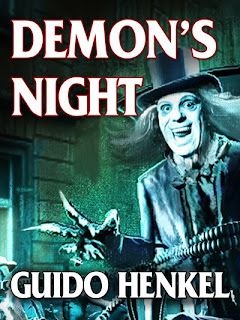
I bought the first Jason Dark ebook, Demon's Night, and found it to be exactly as Henkel describes, a fun, penny-dreadful horror novella, well written, well edited, and compelling.
So why isn't this guy selling?
Here's what I would do.
1. Experiment more with price. Dropping to 99 cents for a short period of time tripled his sales, but he then changed it back to $2.99 too quickly. I'd recommend pricing the first three books in the series at 99 cents, and leaving them there for at least two months. It's a drastic step, but there's really nothing to lose here. He needs to get on some of the genre bestseller lists to get noticed, and he won't get there with rankings of 100,000.
I price my novellas at 99 cents. $2.99 might be a tad too much for a novella. In figuring out the "value" of an ebook, I've determined that it has nothing to do with cover price. Value is determined by how much money an ebook earns. I have a feeling, if he dropped his prices, he'd eventually start selling six times what his is now selling, which means he'll earn more in the long run.
2. Bundle. The more virtual shelf space an author has, the better the chances of being discovered. Henkel has a good opportunity here to add to his shelf-space without having to write more. Why not try combining three Jason Dark novellas into one ebook, and selling that for $2.99? Or selling five ebooks in one package for $4.99? Lots of combinations and possibilities here, and since Henkel is already a pro at cover art and formatting, it won't cost him extra to do this.
3. Wait. I've said many times that the wonderful thing about ebooks is they are forever, and the shelf space is infinite. This means there is time for something to catch on and start selling. In every Kindle success story I've heard about, it took months, or years, before the author became a hit. While it is frustrating to be trying your best and not seeing fabulous sales, this is a marathon, not a sprint. Luck ALWAYS plays a part. It just can take a while. Which brings me to...
4. Keep writing. While ten books in the Jason Dark series is impressive, it might be time for Henkel to try something new. I have 19 ebooks on Kindle right now, with several more being released this year. I've got horror, thriller, mystery, humor, sci-fi, and even some poetry. And I have ZERO clue why some of my ebooks sell better than others. But diversity can only help people find you. And once they find you and like you, they'll buy more of your work.
5. Stop advertising. In my opinion, ads are a huge waste of money. I know a lot of ebook bestselling authors. None of them advertise. It isn't necessary, and in the case of ebooks, I think it's worthless. Also, I'm really not in love with all the ads on Henkel's home page. I'd be curious to know how much income they're bringing in, but in my opinion they'd have to bring in a lot of money to make up for the distraction they cause.
6. Createspace. Henkel's print books look pretty damn cool, but they aren't for sale on Amazon, probably because it's damn near impossible to to get self-pubbed books for sale. But I've found that print and ebook sales, linked together on Amazon, tend to enhance each other.
Createspace will print Henkel's books, and list them on Amazon.com. He might need to bundle them in order to find a decent profit point, but the set-up cost is minimal ($39). There's really nothing to lose in trying.
Those are my immediate ideas. Does anyone have anything to add?
Tuesday, February 08, 2011
The End of the Bestseller
 Blake Crouch and I interview each other in the latest issue of Crimespree Magazine.
I've given up doing interviews, because I get a lot of requests and they all ask the same questions. While it's flattering, I hate taking time away from my writing, and I'm making enough money to stop doing things that I dislike.
That said, I did do a quick interview with Kirkus for Shaken, which is being released in print on February 22.
Some folks may be thinking, "But Joe, interviews are free publicity. If you stay out of the public eye, they'll forget you and stop buying your ebooks. Aren't you shooting yourself in the foot?"
I don't think so. Lots of authors shy away from the spotlight but still sell well. And I'm 99% convinced that name-recognition isn't what drives sales.
So what does?
In the print world, distribution is the Number 1 factor in sales. The more places your book is for sale, the more books you'll sell. It's very much a self-fulfilling prophecy that goes like this:
1. Publisher prints a shitload of books, gets them into as many retail outlets as possible.
2. Publisher buys coop in bookstores and big box stores, offering steep discounts for multiple copies, so the books can be sold for under the cover price.
3. Readers buy these books because they have little choice in places like drug stores, supermarkets, airports, etc, and because in bookstores it is the first thing they see when they walk in; big stacks of discounted books by familiar, safe names.
I don't believe an author becomes a bestseller, and then becomes available everywhere. I believe an author is available everywhere, and that's why they're a bestseller.
If you look at the Kindle bestseller lists, a lot of the ebooks selling well mirror their print counterparts. But more and more, self-published ebooks are creeping onto these lists, displacing traditionally published ebooks.
Obviously, distribution and coop don't play a part in ebook sales, because indie ebooks don't have any.
This allows me to make a rather startling prediction about the future.
The current print bestsellers dominate because they're available everywhere. Readers are creatures of habit. Used to buying Patterson in print, many of them will buy Patterson in ebook form because he is safe and familiar.
So let's do a thought experiment. Let's imagine that every place Patterson has a print book for sale, I also have an equal number of print books for sale. But whereas Patterson's paperbacks are $8.99, my paperbacks are $2.99.
Do you think he'd still outsell me in print?
Remember, for every book he has on the shelf, I have one that is equally displayed. Though he enjoys a much larger fanbase and name-recognition, if there were displays touting my price, I think I could outsell him.
A pipe dream? Hardly.
Because I DO outsell Patterson on many of the Kindle bestseller lists, simply because I have a lower price.
Now, if we take away Patterson's print sales (or at least reduce them when ebooks sales overtake print) it is simple to predict what will happen.
Ebooks are all equally distributed. They have an infinite shelf-life, and infinite shelf-space. Everywhere Patterson has an ebook, I have an ebook. And I can beat him on price, so I can beat him in sales.
Kindle readers are still buying overpriced bestsellers because that's how they're used to shopping. However, the many of the ereader owners I've spoken with are changing their buying habits.
At one time, the majority of readers bought what was widely distributed.
But with ereader owners, price is often a major factor in a purchase.
The Big 6 can't publish ebooks priced low enough to compete with me. They have fancy NY offices, lots of employees with benefits and expense accounts, and a whole industry to support.
With print, they know how to create a bestseller. They buy it.
They buy the real estate. They buy the advertising. They buy the discounts.
But in an ebook world, their money offers no advantage. They can't get more shelf space or a longer shelf life than I can, and they can't discount for less than I can.
Now certainly bestselling authors will still have fans when the print industry collapses, and those fans will have no choice but to switch to ebooks.
So far, those fans have been willing to put up with $9.99 and $12.99 prices.
I don't see this happening forever. Right now, we're in a transitional period. The stranglehold NY publishing has had on the US, forcing people to read what they decide to make available, is loosening up. When given a choice, readers will buy books other than those vetted by NY. The Kindle bestseller lists prove this. My sales prove this.
In the future, coop and distribution won't be the main reason a book sells. Price and content will be.
In said future, will Patterson be happy with 25% royalties on a $9.99 ebook when he could make more money self-pubbing a $2.99 ebook which would sell ten times as many copies?
I think not.
"But Joe," you may say, "When Patterson is self-pubbing at $2.99, how will you compete?"
That's the beauty of ebooks. There is no competition.
When I used to buy music, I was limited by price, by space, by the physicality of the object, and by the places it was available.
Price was prohibitive. A $15 CD meant I had to be picky and choosy when buying, lest I run out of money.
Space was prohibitive. After you buy a few hundred albums, you run out of places to put them.
The tangibility of a CD gave it weight, both physically and psychologically. It was an object that existed, which gave it value and permanence. Buying something valuable and permanent meant actually thinking about whether or not to make the purchase.
Often, I had to visit different stores to find the CD I wanted. This process took time, and effort.
Then iTunes came along.
Price was no longer prohibitive. I could cheaply buy whatever I wanted.
I didn't have to take up a shelf when I bought the music--it fit right on my hard drive.
Because it was one-click buying, I was more apt to download something than buy a tangible object. Which meant it required less thought. Ask any Kindle owner if they buy more books now that they own an ereader, and the overwhelming majority will say yes. Especially since the don't need to leave their house, or their sofa, to do so.
So let's apply this to books.
In the past, a reader would have to physically visit a store, then decide to buy Patterson's new hardcover for $15.99 or my new hardcover for $24.99 (if mine was even available there). To make this decision, the reader had to come to grips with the fact that they were buying an expensive, permanent object, that once purchased will take up space in the home.
Making decisions is tough. Especially when it comes to your entertainment dollar. Why take a chance on an unknown author for $25 when NY publishers make it easy to get a sure thing for $16?
So Patterson has vastly outsold me in print.
But with ebooks, it is much easier to make decisions. Cheap, intangible downloads don't require as much thought. Las Vegas has proven that once you take away cash and credit cards and replace them with chips and tokens, people are freer with their spending. The same thing applies to clicking a BUY NOW button on a computer or Kindle that is hooked up to your account.
So I'm no longer competing with Patterson. If he's $2.99 and I'm $2.99, readers won't hesitate to buy both of us.
In fact, once he and all the other bestselling authors start self-publishing and come down in price, that will leave more money in readers' pockets to spend on unknowns like me.
The next obvious question involves time. If every ebook is cheap, and readers pig out on them like we do at an all-you-can-eat buffet, where will anyone find the time to read all of those ebooks?
Answer: they won't.
Admit it, you've bought books before but haven't gotten around to reading them yet. Just like you've rented movies you didn't watch, bought music you haven't listened to, and bought a DVD set of some TV show that still has two discs you haven't gotten to yet.
We all have to-be-read piles. The Kindle has just made them bigger, cheaper, and easier to attain.
There is a lot of allure to pressing a button, getting an ebook download, and having it on your device to be read later. It's like a squirrel storing up nuts for winter. It gives us comfort knowing we have it.
Conclusions?
In the future, we will no longer have the same bestsellers we have now. People will be buying more books, but more of them will be going unread. There won't be competition, because no one goes to a buffet and gets the pizza or the lasagna--they get the pizza AND the lasagna, even if they don't eat one of them.
Ebooks will continue to gobble up market share once held by print books. Chain bookstores will close. Publishers will have to downsize or go bankrupt. Big name authors will self-publish, making less money than they did before, but having more control and getting a larger percentage of royalties. The playing field will truly be even, readers will find what they want to read without having it crammed down their throats by NY, and the cream will rise to the top.
And that, my friends, is a fairy tale ending in every sense of the term.
Thursday, February 03, 2011
Guest Post by B.V. Larson
Here's more fuel for the fire.
Last month, I thought I did pretty good by selling 22,000 ebooks.
Of course, we all know the reason I sold so many is because I was previously published and I have a platform and my traditional print books and fanbase all played a huge part.
Not.
Allow me to introduce you to B.V. Larson, who creamed my sales even though he had none of the above. I noticed him a year or so ago, with his ebook Mech.
But better to let him tell you in his own words. Here's Larson:
 The Past:
My ebook odyssey began in April 2010, when I rediscovered Joe’s blog (thanks again, Joe) and read about how well he was doing on Amazon. I decided to give it a try after many years of firing blindly at New York.
I’d been successful in non-fiction (have a textbook series), but I’d never managed more than a few pro short story sales in fiction. I’ve actually had three agents and many “rewrite this” and “almosts” with editors.
When I started ebooking I’d never laid eyes on a Kindle, but by the end of May I had two books up and 7 big sales. Things grew rapidly from there, and over the last six months I've had over 100,000 PAID ebook sales, including 26,000 in December and 38,000 in January. Most of these sales were for $2.99.
I did it all without a fan-base or a web-presence. I had nothing going for me other than determination, a pile of unsold manuscripts and a willingness to adapt.
My point is: Indies can succeed.
The Present:
In January, Amazon made me their first "Featured Author" in the new DTP newsletter. I've had a few calls from publishers and the like, but I've stayed completely independent thus far. I’m not philosophically opposed to working with traditional publishing. I take a business-like view: if someone can convince me that signing a deal with them is worthwhile, I’ll sign it. This is best done mathematically, however, not with slogans and promises of glory.
On the personal side, no one is more stunned by my success than I am. In truth, I’m feeling my way through this new universe. I feel like it’s 1993 and I just figured out how to make a website. The world is wide open at this point.
The Future:
Things are very likely to become dramatic in this industry. I seriously see the current publishing structure as unsupportable. Tech has a way of doing that (look it up in an econ book, it’s called “creative destruction”). There is bound to be a period of turmoil when new business methods are applied. Hardest hit will be those who can’t adapt, like silent movie stars trying to find work in “talkies”. Or like radio stars trying to make the transition to TV. Writers and actors were once paid a salary by movie studios. Things change.
By 2020, I would be very surprised if printed materials weren’t the exception, rather than the rule. If you don’t believe me, take a look at that MP3 player in your pocket and ask yourself how many CDs, cassette tapes or 8-tracks you’ve bought lately.
Logically, the most indispensable individual is the creator of the content in any industry. Authors are the factories, and therefore we are the one thing that can’t be eliminated. Who was that publisher who famously said: “This would be a great business if it weren’t for the authors”? Such attitudes must be rethought.
The two things you have to have in this business are the author and the reader, so the real stress will fall on the packagers and distributors in between us. My goal is to stay calm and focus on my work. I’m only concerned about my readers. If I keep them happy, they will keep me happy.
Advice:
There are a thousand useful pieces of advice right here on this website. I won’t repeat them. But I will tell you my guiding light: writing is all about the reader. I never sit down and start out thinking about “what I’d like to write.” I start out with what I’d like to read. I’m even more interested in what others would like to read. I think about the reader all the time—where they are in their minds, where they want to go next—then I write until they get there. Writing is not about me. It’s about my readers.
Joe sez: First of all, I'm staggered and thrilled Larson has sold so well. He's the perfect example of what I've been talking about. Write good books at fair prices and publish a bunch of them and you'll sell even if no one knows who you are.
I also say that the cover art must be good. While I like the cover art for Mech, I'm not too keen on some of Larson's other book covers. But then, I'm not hot for Amanda Hocking's covers either, and those haven't seemed to hurt her sales.
This leads to an interesting conclusion. Larson has sold 100,000 ebooks. But that doesn't mean he has 100,000 fans. He might only have 6000 fans. But these fans could have each bought his entire oeuvre, 18 ebooks.
If you're writing good books that fans enjoy, they'll seek out more of your work. The more of your work you have available, the more chances you'll have to discover new fans. It's like constantly making your fishing net bigger. The bigger the net, the more fish you'll snare.
For those writers who are wondering why they haven't had decent sales, my answer is: write more.
In fact, that's always been the answer for writers, no matter what their goals are.
Last month, I thought I did pretty good by selling 22,000 ebooks.
Of course, we all know the reason I sold so many is because I was previously published and I have a platform and my traditional print books and fanbase all played a huge part.
Not.
Allow me to introduce you to B.V. Larson, who creamed my sales even though he had none of the above. I noticed him a year or so ago, with his ebook Mech.
But better to let him tell you in his own words. Here's Larson:
The Past:My ebook odyssey began in April 2010, when I rediscovered Joe’s blog (thanks again, Joe) and read about how well he was doing on Amazon. I decided to give it a try after many years of firing blindly at New York.
I’d been successful in non-fiction (have a textbook series), but I’d never managed more than a few pro short story sales in fiction. I’ve actually had three agents and many “rewrite this” and “almosts” with editors.
When I started ebooking I’d never laid eyes on a Kindle, but by the end of May I had two books up and 7 big sales. Things grew rapidly from there, and over the last six months I've had over 100,000 PAID ebook sales, including 26,000 in December and 38,000 in January. Most of these sales were for $2.99.
I did it all without a fan-base or a web-presence. I had nothing going for me other than determination, a pile of unsold manuscripts and a willingness to adapt.
My point is: Indies can succeed.
The Present:
In January, Amazon made me their first "Featured Author" in the new DTP newsletter. I've had a few calls from publishers and the like, but I've stayed completely independent thus far. I’m not philosophically opposed to working with traditional publishing. I take a business-like view: if someone can convince me that signing a deal with them is worthwhile, I’ll sign it. This is best done mathematically, however, not with slogans and promises of glory.
On the personal side, no one is more stunned by my success than I am. In truth, I’m feeling my way through this new universe. I feel like it’s 1993 and I just figured out how to make a website. The world is wide open at this point.
The Future:
Things are very likely to become dramatic in this industry. I seriously see the current publishing structure as unsupportable. Tech has a way of doing that (look it up in an econ book, it’s called “creative destruction”). There is bound to be a period of turmoil when new business methods are applied. Hardest hit will be those who can’t adapt, like silent movie stars trying to find work in “talkies”. Or like radio stars trying to make the transition to TV. Writers and actors were once paid a salary by movie studios. Things change.
By 2020, I would be very surprised if printed materials weren’t the exception, rather than the rule. If you don’t believe me, take a look at that MP3 player in your pocket and ask yourself how many CDs, cassette tapes or 8-tracks you’ve bought lately.
Logically, the most indispensable individual is the creator of the content in any industry. Authors are the factories, and therefore we are the one thing that can’t be eliminated. Who was that publisher who famously said: “This would be a great business if it weren’t for the authors”? Such attitudes must be rethought.
The two things you have to have in this business are the author and the reader, so the real stress will fall on the packagers and distributors in between us. My goal is to stay calm and focus on my work. I’m only concerned about my readers. If I keep them happy, they will keep me happy.
Advice:
There are a thousand useful pieces of advice right here on this website. I won’t repeat them. But I will tell you my guiding light: writing is all about the reader. I never sit down and start out thinking about “what I’d like to write.” I start out with what I’d like to read. I’m even more interested in what others would like to read. I think about the reader all the time—where they are in their minds, where they want to go next—then I write until they get there. Writing is not about me. It’s about my readers.
Joe sez: First of all, I'm staggered and thrilled Larson has sold so well. He's the perfect example of what I've been talking about. Write good books at fair prices and publish a bunch of them and you'll sell even if no one knows who you are.
I also say that the cover art must be good. While I like the cover art for Mech, I'm not too keen on some of Larson's other book covers. But then, I'm not hot for Amanda Hocking's covers either, and those haven't seemed to hurt her sales.
This leads to an interesting conclusion. Larson has sold 100,000 ebooks. But that doesn't mean he has 100,000 fans. He might only have 6000 fans. But these fans could have each bought his entire oeuvre, 18 ebooks.
If you're writing good books that fans enjoy, they'll seek out more of your work. The more of your work you have available, the more chances you'll have to discover new fans. It's like constantly making your fishing net bigger. The bigger the net, the more fish you'll snare.
For those writers who are wondering why they haven't had decent sales, my answer is: write more.
In fact, that's always been the answer for writers, no matter what their goals are.
Wednesday, February 02, 2011
Love is Murder
I've given up speaking in public, doing interviews, responding to people who want my help in some way, traveling around the country signing books, and several other things I don't enjoy about my career.
I no longer require the approval of others, no longer need to help everyone reach their goals, and no longer want to spend time self-promoting to sell print books in a dying industry. I've always believed advertising is worthless, and these days I see no need for extensive self-promotion.
After all, without doing any of the above-mention things, I made over $40,000 in January. All through self-publishing.
So I've finally reached a point where I can do what I want to do, maximizing my happiness, minimizing discomfort, without having to answer to anyone.
It's glorious.
That said, I'll be making what will likely be my final public appearance for a while, this weekend.
Love is Murder is a Chicago-based mystery writing convention taking place this weekend, February 4-6. at the Intercontinental O'Hare.
I'm doing a panel about ebooks, and it'll be the last time you can corner me one-on-one and personally pick my brain.
My panel is 11 to 12 on Saturday, and Saturday night I'm also going to be hosting a gameshow with the headliners, including F. Paul Wilson, Joseph Finder, Rhys Bowen, and other big shots. The game is called Stump the Stars, where I read sections from their books and see if they recognize them. When they don't, I publicly humiliate them. It's a fun time.
So if you're a writer in the Midwest, it's worth digging out of the snow to attend Love is Murder. Lots of good panels, the fine company of your peers, and I'm bringing a few bottles of expensive whiskey and I'm known to throw room parties.
Hope to see you there.
I no longer require the approval of others, no longer need to help everyone reach their goals, and no longer want to spend time self-promoting to sell print books in a dying industry. I've always believed advertising is worthless, and these days I see no need for extensive self-promotion.
After all, without doing any of the above-mention things, I made over $40,000 in January. All through self-publishing.
So I've finally reached a point where I can do what I want to do, maximizing my happiness, minimizing discomfort, without having to answer to anyone.
It's glorious.
That said, I'll be making what will likely be my final public appearance for a while, this weekend.
Love is Murder is a Chicago-based mystery writing convention taking place this weekend, February 4-6. at the Intercontinental O'Hare.
I'm doing a panel about ebooks, and it'll be the last time you can corner me one-on-one and personally pick my brain.
My panel is 11 to 12 on Saturday, and Saturday night I'm also going to be hosting a gameshow with the headliners, including F. Paul Wilson, Joseph Finder, Rhys Bowen, and other big shots. The game is called Stump the Stars, where I read sections from their books and see if they recognize them. When they don't, I publicly humiliate them. It's a fun time.
So if you're a writer in the Midwest, it's worth digging out of the snow to attend Love is Murder. Lots of good panels, the fine company of your peers, and I'm bringing a few bottles of expensive whiskey and I'm known to throw room parties.
Hope to see you there.
Subscribe to:
Posts (Atom)


